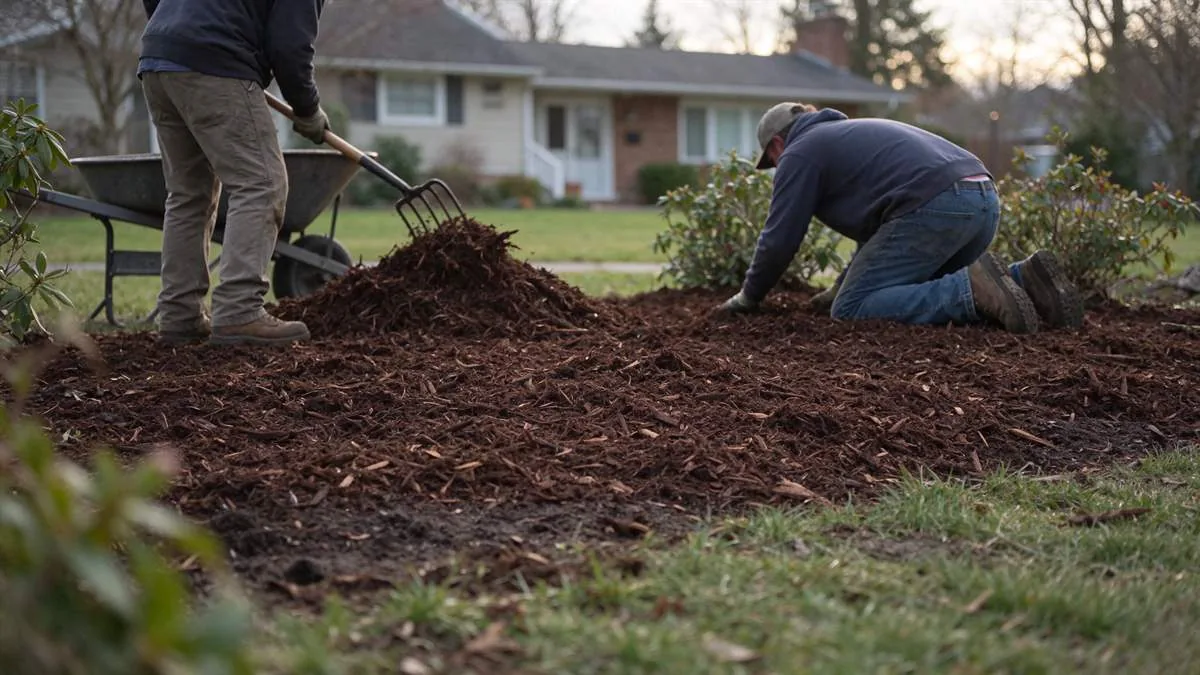
Mulch is the only material in this series that you buy more than once. Paint you buy once and it lasts seven years. Gravel you buy once and it lasts until somebody drives off the edge. Mulch is consumed — by weather, by soil organisms, by the simple fact that bark shreds break down — and that changes the question from "how much do I need" to "how much do I need to buy, and how often".
Both answers come from the same three inputs as every other bulk material, so start there.
1. Volume from area and depth
Area in square feet, depth in inches converted to feet, multiply, divide by 27. That is the whole formula, and it is worth doing once by hand so the number means something:
400 sq ft x 0.25 ft = 100 cubic feet = 3.70 cubic yards.
In bags of 2 cubic feet that is exactly 50 bags, because 2 cubic feet divides 100 without a remainder.
Bulk: 3.70 yd at $32 = $118, plus a $105 delivery = $223. Bagged: 50 bags at $4.20 = $210.
The bagged option wins that comparison, by $13, which surprises people who assume bulk is always cheaper. It is cheaper per cubic foot — $1.19 against $2.10 — but on a load this small the delivery charge is bigger than the saving. That reversal is the heart of this guide and we will come back to it in section 4.
One thing to check before you trust the number: whether the bed is really 400 square feet. Garden beds are rarely rectangles, and the common error is measuring the outer edge of a curved bed instead of the actual planted area. A bed that curves around three shrubs can easily be 20 percent less area than its bounding rectangle. Estimate it as a series of rectangles and triangles, and if you are within 10 percent you are close enough — mulch is not concrete.
2. Two inches or three is the only depth question worth arguing about
Published guidance converges on 2 to 4 inches, with 3 inches as the working standard for a fresh bed. The reasons for each end of that range are different, and only one of them is about money:
- Below 2 inches the layer does not suppress weeds. Annual weed seed can germinate through an inch of bark, and perennial grasses like quackgrass push straight through it. You get the look of mulch without the function.
- At 2 to 3 inches you get weed suppression, moisture retention, and a layer thick enough that soil temperature swings are damped. This is the range that works.
- Above 4 inches the layer starts to interfere with air and water moving into the soil, and shallow-rooted plants suffer. It also costs more for no additional benefit, because the extra depth breaks down at the same rate as the first three inches.
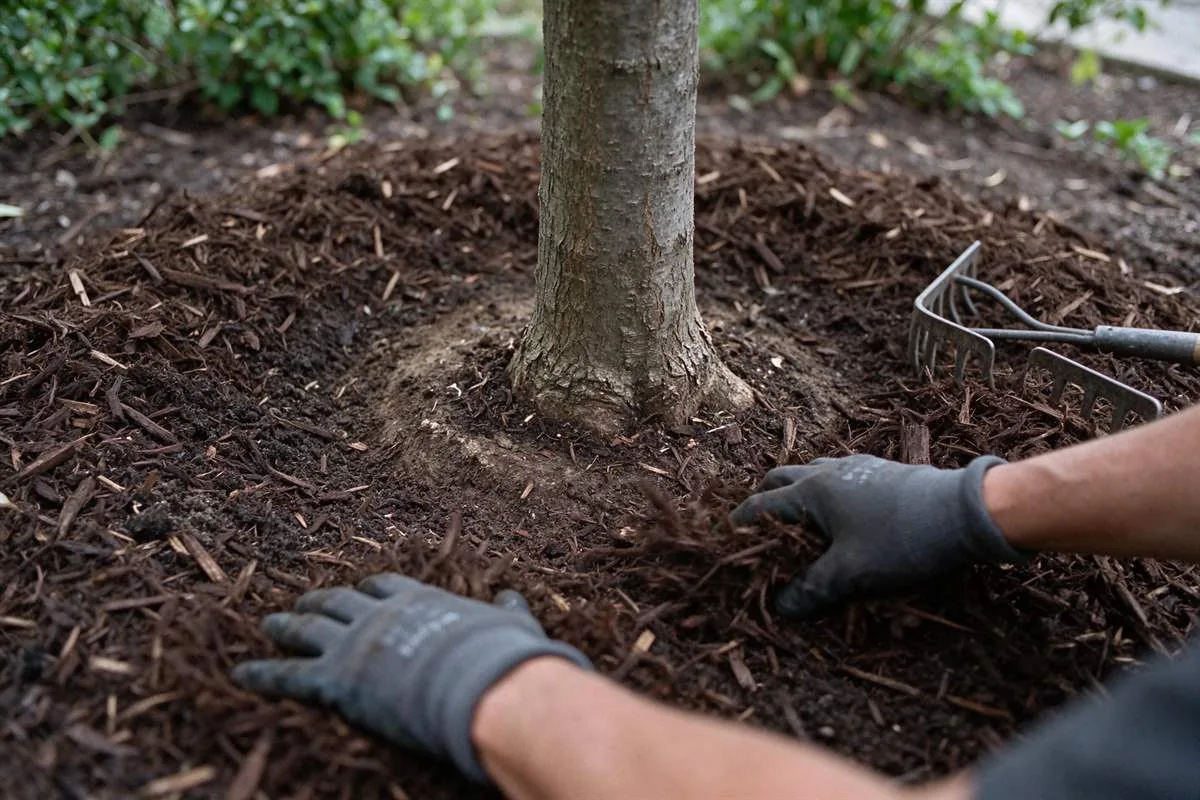
The mistake that costs the most is not the depth, it is the shape. Mulching up against a trunk in a cone — the volcano look — keeps bark permanently damp, invites rodents to nest against the trunk, and slowly kills the tree in a way that takes five years to diagnose. Pull the mulch back so there is a 2 to 3 inch ring of bare soil around the trunk, and keep the layer level rather than domed.
In beds, 3 inches is also the depth that lets you skip a step: at 3 inches you do not need to pull the old mulch first, because the new layer covers it and the old one breaks down underneath. At 1 or 2 inches you are adding to a layer that is visibly thinning and the bed looks patchy until the next season.
3. Depth does not change what you spend. It changes how often the truck comes
This is the number nobody publishes, and it is the reason the depth question gets argued in the wrong terms. Mulch decomposes at roughly an inch a year in a temperate climate. That rate does not care how deep you started. So over five years, every depth ends up delivering almost exactly the same total volume to the bed:
| First layer | Year 1 volume | Top-ups in 5 years | 5-year material | 5-year cost at $32/yd |
|---|---|---|---|---|
| 1 inch | 1.23 yd | every year, 5 top-ups | 7.4 yd | $236 |
| 2 inches | 2.47 yd | 4 top-ups | 7.4 yd | $237 |
| 3 inches | 3.70 yd | 3 top-ups | 7.4 yd | $237 |
| 4 inches | 4.94 yd | 2 top-ups | 7.4 yd | $237 |
Every column lands within a dollar of every other. That is not an accident of the example — it is what a constant decomposition rate does. A deeper first layer is not cheaper and it is not more expensive. It is the same amount of bark, paid for earlier.
So why does depth matter at all? Because of what is attached to each order rather than the material itself. Each top-up is a separate delivery with its own $105 charge, or a separate trip with your own trailer:
| First layer | Truck visits in 5 years | Material | Delivery | Total |
|---|---|---|---|---|
| 1 inch | 6 | $236 | $630 | $866 |
| 2 inches | 5 | $237 | $525 | $762 |
| 3 inches | 4 | $237 | $420 | $657 |
| 4 inches | 3 | $237 | $315 | $552 |
Now the depth is worth $314 across five years, and every cent of it is delivery, not mulch. Which means the correct way to read this table is as a question about logistics, not about gardening: if you can collect it yourself, or if your supplier charges one fee for a season's worth of drop-offs, the whole difference collapses and any depth from 2 to 3 inches is equally cheap. If you cannot, 3 inches is the depth that halves the number of times you have to be home for a truck.
4. Bulk or bagged: the break-even is 4.25 cubic yards
Bulk mulch is $32 a cubic yard. Bagged mulch is $4.20 for 2 cubic feet, and since a cubic yard is 13.5 such bags, that is $56.70 per cubic yard — 77 percent more. Against a $105 delivery charge, the arithmetic is:
Four and a quarter cubic yards is 115 cubic feet, or 459 square feet at 3 inches. Below that, bags are cheaper. Above it, bulk wins and the margin widens by $24.70 for every additional yard.
That makes a 400 square foot bed a genuine bag job — $210 against $223 — and a 600 square foot bed a genuine bulk job. The crossover sits almost exactly at the size of a typical front-yard bed, which is why two neighbours on the same street can both be right about the cheaper option.
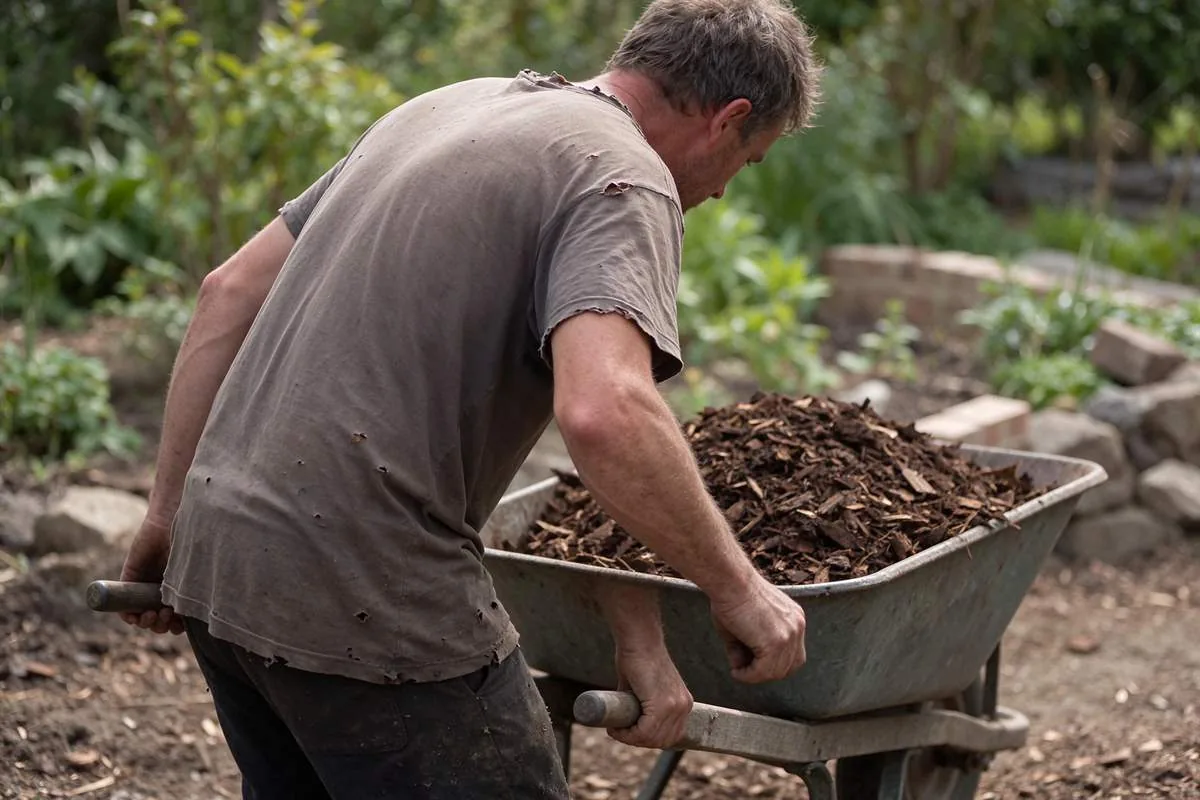
There is a practical asymmetry in favour of bulk that the price does not show: 50 bags is fifty trips to the car, fifty cut bags to dispose of, and about three hours. Bulk is one pile, tipped where you want it. On a $13 difference, most people who have done both would pay the $13.
And one asymmetry in favour of bags: you can buy eight of them for a bed that needs eight, whereas bulk yards sell in half or full yards and will not split a load. For a small repair, bags are not a compromise, they are the only sensible unit.
5. The bag is not always two cubic feet
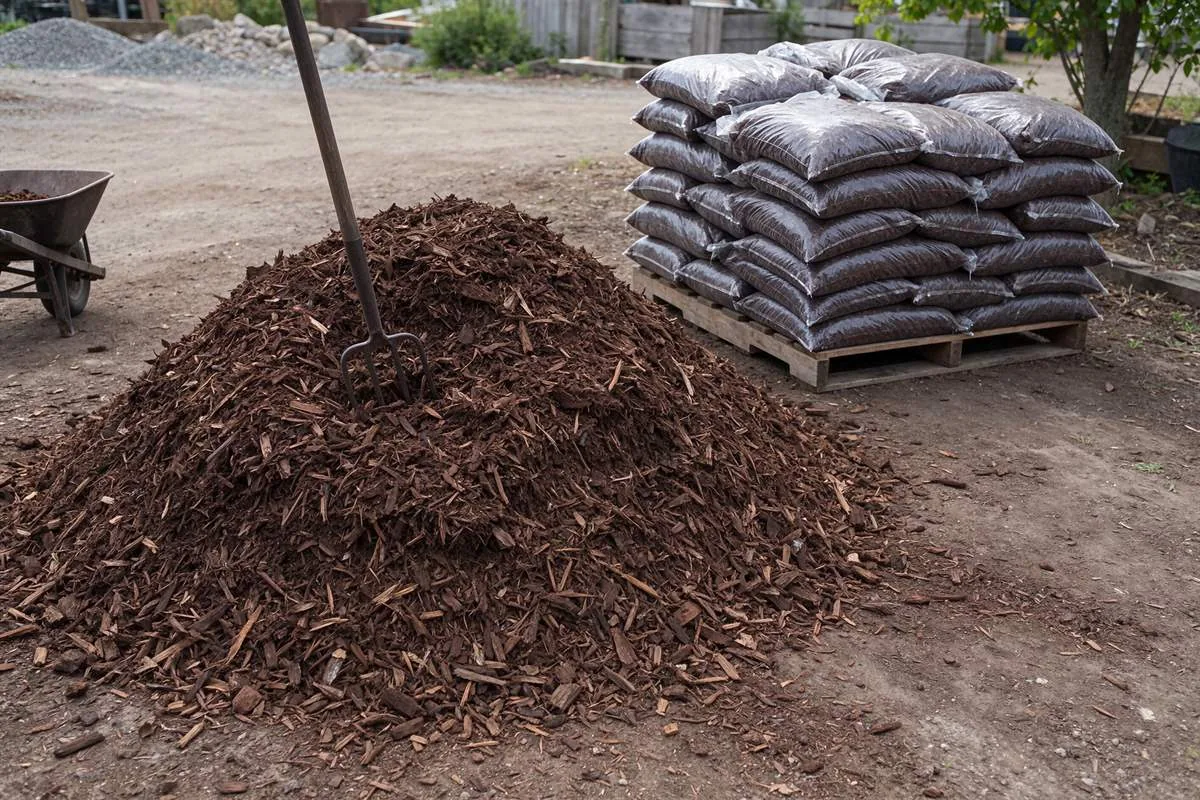
Two cubic feet is the standard mulch bag, but it is far from the only size on the shelf. Bags of 1.5, 2 and 3 cubic feet all sell side by side, and they are priced to make the comparison as hard as possible. A cubic yard holds:
| Bag size | Bags per cubic yard | Cost per cubic foot at $4.20 a bag | Cost per cubic yard |
|---|---|---|---|
| 1.5 cu ft | 18 | $2.80 | $75.60 |
| 2 cu ft | 13.5 | $2.10 | $56.70 |
| 3 cu ft | 9 | $1.40 | $37.80 |
The jump from a 1.5 to a 3 cubic foot bag is a factor of two in volume and a factor of two in cost per cubic foot — and a 3 cubic foot bag is heavy and awkward, which is exactly why it is priced the way it is. If a store sells a 3 cubic foot bag for $5.50, that is $1.83 per cubic foot against the 2 cubic foot bag's $2.10, and for a 400 square foot bed the difference is about $25. It pays to read the cubic feet on the front of the bag, not the price tag.
The same arithmetic explains why "one pallet of 65 bags" deals are usually not deals. A pallet is a logistics unit, not a volume, and the bag size inside it can change from one delivery to the next.
6. What mulch does not do
Three claims about mulch circulate widely and all three are wrong in ways that lead to bad purchases:
It does not rob nitrogen from the soil. That is true of uncomposted material mixed into the soil, where microbes draw nitrogen from the surrounding soil to break it down. Mulch sits on top, the interface is a fraction of an inch thick, and the effect on plants is negligible. This myth sells a lot of expensive composted product.
It does not need fabric underneath. Weed fabric under mulch blocks the organic matter from returning to the soil, tears within two seasons, and weeds germinate happily in the mulch layer above it anyway. The only place fabric earns its keep is under gravel or stone, where there is no decomposition to feed.
It should not touch the house. Termites do not seek out mulch, but a deep band of mulch against a foundation gives them a concealed route that stays damp. Keep a 6 inch gap of bare ground between the mulch edge and the wall, and keep the layer below the top of the foundation.
What mulch actually does: holds soil moisture, damps temperature swings, suppresses annual weeds, prevents crusting and erosion from rain impact, and adds organic matter as it breaks down. That is a strong enough list that it does not need the myths.
7. The whole order, priced
| Item | Quantity | Basis | Cost |
|---|---|---|---|
| Shredded bark mulch | 3.70 cu yd | 400 sq ft at 3 in | $118 |
| Delivery | 1 load | flat fee, small order | $105 |
| Bulk total | $223 | ||
| Bagged equivalent | 50 x 2 cu ft | same 100 cu ft | $210 |
No tools are in this order and none need to be, assuming you own a rake and a wheelbarrow. If you do not, a pitchfork moves mulch faster than a shovel, a stiff leaf rake levels it faster than a bow rake, and a wheelbarrow with a pneumatic tyre is worth the extra $30 on anything larger than 200 square feet.
The labour is genuinely the larger cost on a bag job: 50 bags at 2 cubic feet is roughly 2.75 tons of material moved from a car boot to a bed, one bag at a time. That is a solid afternoon, and it is the reason the bulk option wins on any bed large enough to justify the delivery fee even when the per-yard price is not the deciding factor.
8. The short version
Area times depth times one-twelfth gives cubic feet; divide by 27 for cubic yards. At 3 inches, 100 square feet needs almost exactly one cubic yard, which is a useful mental anchor. Choose 3 inches for a fresh bed: 2 is the minimum that suppresses weeds and 4 buys nothing extra.
For the purchase, calculate the break-even rather than guessing: delivery divided by the difference in price per yard. At typical 2026 prices that lands at about 4.25 cubic yards, so bags win below 460 square feet and bulk wins above it. Then read the cubic feet on the bag, not the price, because bag sizes vary by a factor of two.
And plan the next four years, not just this one. The material cost of a deeper layer and a shallower one is identical over five years; the difference is how many times a truck has to come.