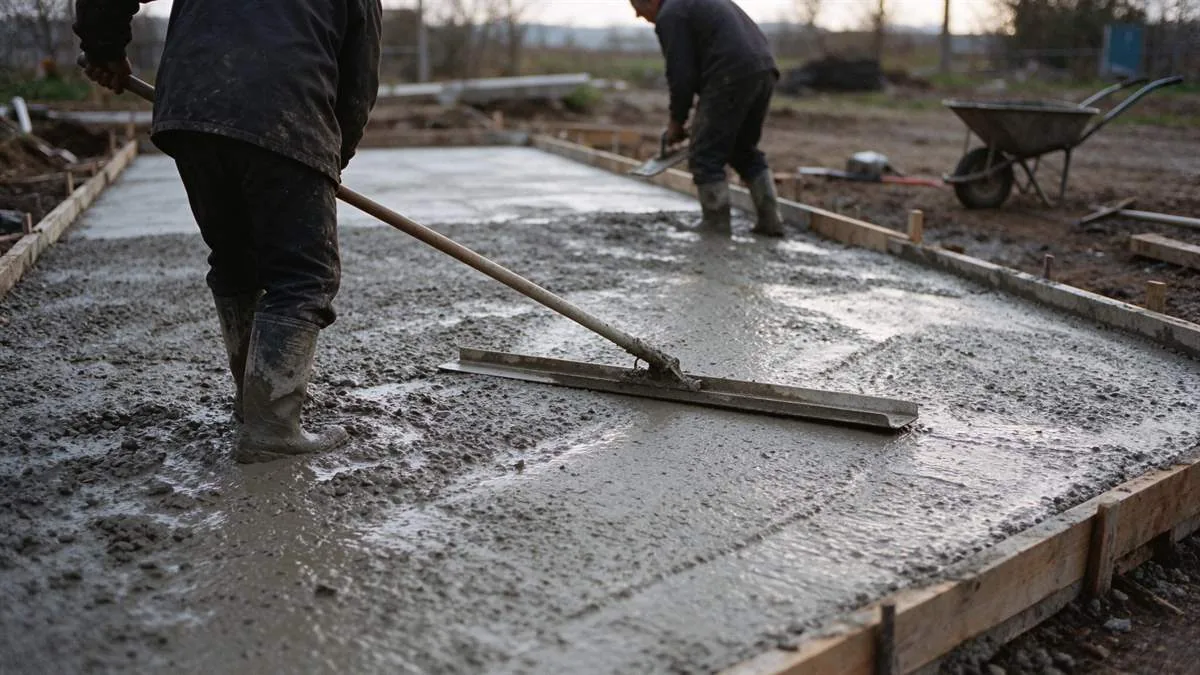
Concrete is the only material here that has a deadline attached to it. Paint can sit in the garage for a year, gravel keeps. Mixed concrete starts setting within an hour, and if you order short there is no second trip — the pour you are halfway through is the pour you are stuck with.
That changes the arithmetic in one specific way: you round up, and you round up before you order, not while the mixer is running.
1. Volume first, and the shape decides the formula
Concrete is ordered in cubic yards, and a cubic yard is 27 cubic feet. Three shapes cover almost every domestic job:
| Shape | Formula | Example | Volume |
|---|---|---|---|
| Slab or pad | L x W x T, all in feet | 10 x 10 at 4 in | 33.3 cu ft = 1.24 yd |
| Strip footing | length x width x depth | 40 ft x 16 in x 8 in | 35.6 cu ft = 1.32 yd |
| Round column | 3.14 x r x r x h | 10 in dia x 4 ft | 2.2 cu ft = 0.08 yd |
100 sq ft x 0.333 ft = 33.3 cubic feet = 1.24 cubic yards.
Add 10 percent for an uneven subgrade = 1.36 cubic yards, which is what you actually order.
In 60 lb bags that is 82 bags. From a truck it is a 1.5 yard short load.
Note the trap in the first row: 4 inches is a third of a foot, so the slab is a third of the footprint in volume. Get the thickness wrong and you are wrong by exactly that ratio — at 6 inches this slab is 1.85 cubic yards before waste, which is 50 percent more concrete and 50 percent more money. Thickness is the input that has to be right, and it is the one most often guessed.
Footings and columns are easier to under-count because they are small individually and there are many of them. A 40 foot footing run at 16 by 8 inches is 1.32 yards on its own, and a porch with two of them plus a slab is a truck job no matter what the slab says.
2. Bags or a truck: the break-even is near one cubic yard
Here is the comparison for the slab above, at 2026 retail prices:
| 60 lb bags | Ready-mix truck | |
|---|---|---|
| Quantity | 82 bags | 1.5 cu yd (short load) |
| Price | $6.80 a bag | $212 a yard |
| Total | $558 | $318 |
| Weight moved by hand | 4,920 lb | none |
| Mixing time | 4 to 6 hours | 20 minutes |
The truck is $240 cheaper and takes a fraction of the time, and this is only a 1.5 yard pour. So why does anyone buy bags?
Because a truck has a minimum, and below that minimum the fee structure changes completely. Most ready-mix suppliers will not send a truck for less than 1 cubic yard, some not for less than 2, and a part-load carries a short-load charge of $40 to $70 per yard. Where access is tight — a narrow driveway, a back garden with no gate wide enough — a truck cannot reach the pour at all and bags are the only option regardless of price.
The break-even itself is a clean equation. Set the cost of bagged concrete per yard at $408 (60 bags of 60 lb at $6.80), the truck at $212 a yard, and the short-load fee at F:
So the line sits between about three quarters of a yard and a yard and a quarter, depending on what your supplier charges. Below it, bags are cheaper; above it, the truck wins and keeps winning by $196 for every additional yard.
For scale, 0.77 cubic yards is 21 cubic feet, which is 35 bags of 80 lb or 47 bags of 60 lb. Practically, that is a single set of steps, a small pad, or a repair. Anything with a slab in it is over the line.
3. The bag yield table, because 80 lb bags are nearly twice the concrete
Bag sizes are not proportional to what they produce in a tidy way, and the per-yard cost varies more than the shelf price suggests. One cubic yard is 27 cubic feet:
| Bag | Yield per bag | Bags per cubic yard | Price each | Cost per cubic yard |
|---|---|---|---|---|
| 40 lb | 0.30 cu ft | 90 | $4.80 | $432 |
| 50 lb | 0.375 cu ft | 72 | $5.80 | $418 |
| 60 lb | 0.45 cu ft | 60 | $6.80 | $408 |
| 80 lb | 0.60 cu ft | 45 | $8.50 | $383 |
The 80 lb bag is the cheapest concrete per yard, by $25 over the 60 lb, and by $49 over the 40 lb. It is also the heaviest thing you will lift all day, forty-five times. If the pour is small, buy 80 lb and save both money and the second trip. If there are stairs involved, the 60 lb bag exists for exactly that reason and the $25 is the price of your back.
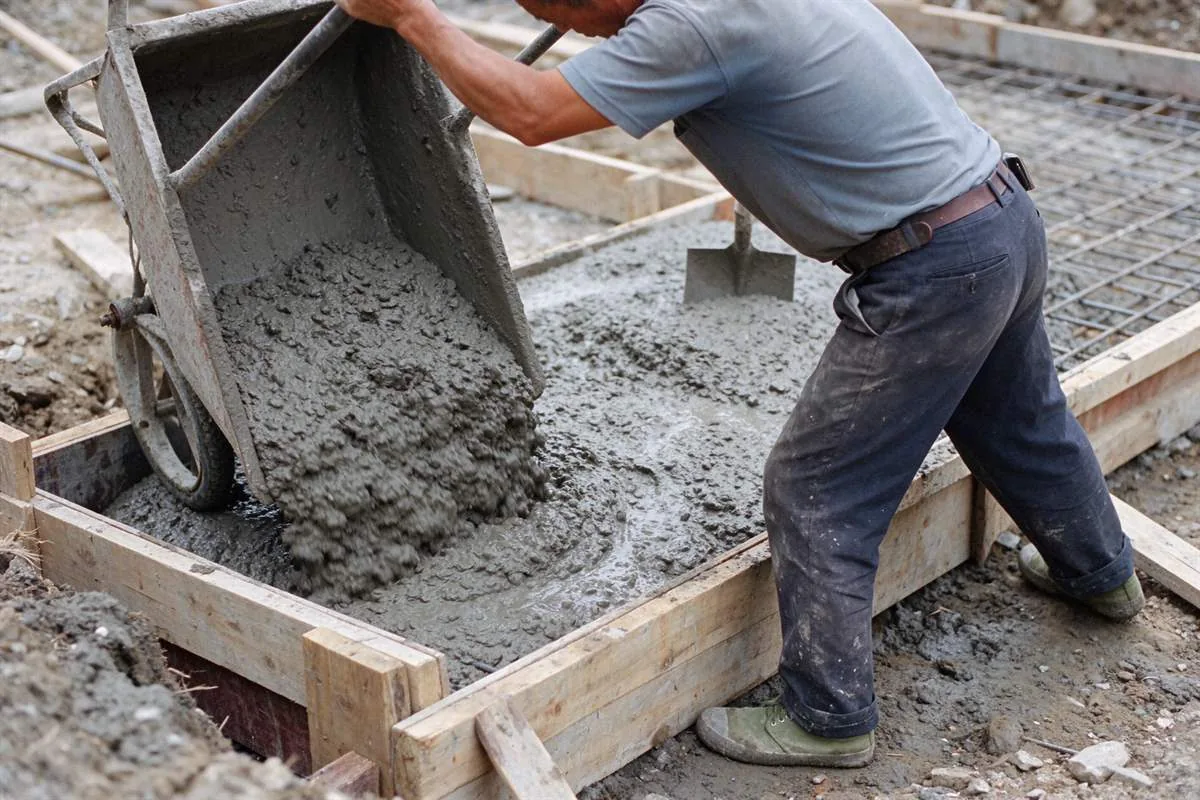
Two bag details that catch people. A bag that has been sitting in a damp shed for a season is partly set, and no amount of mixing brings it back — buy from a store with turnover and check the date on the bag. And a bag mixed in a wheelbarrow is usually mixed too wet, because water makes it easier to turn over; the correct ratio is about 2.5 to 3 quarts per 60 lb bag, and concrete that has been over-watered loses roughly a third of its strength.
4. The short-load fee is the number nobody quotes
Ask a ready-mix supplier for a price and you will get a price per yard. It will not be the price you pay, and the difference is not small.
A standard truck carries 10 cubic yards. Anything less is a part load, and the supplier charges for the empty space in the drum, because the truck could have been earning on another job. That charge is typically $40 to $70 per yard under 5 yards, or a flat minimum order of $150 to $300. On a 1.5 yard order the fee can be 30 to 50 percent of the total.
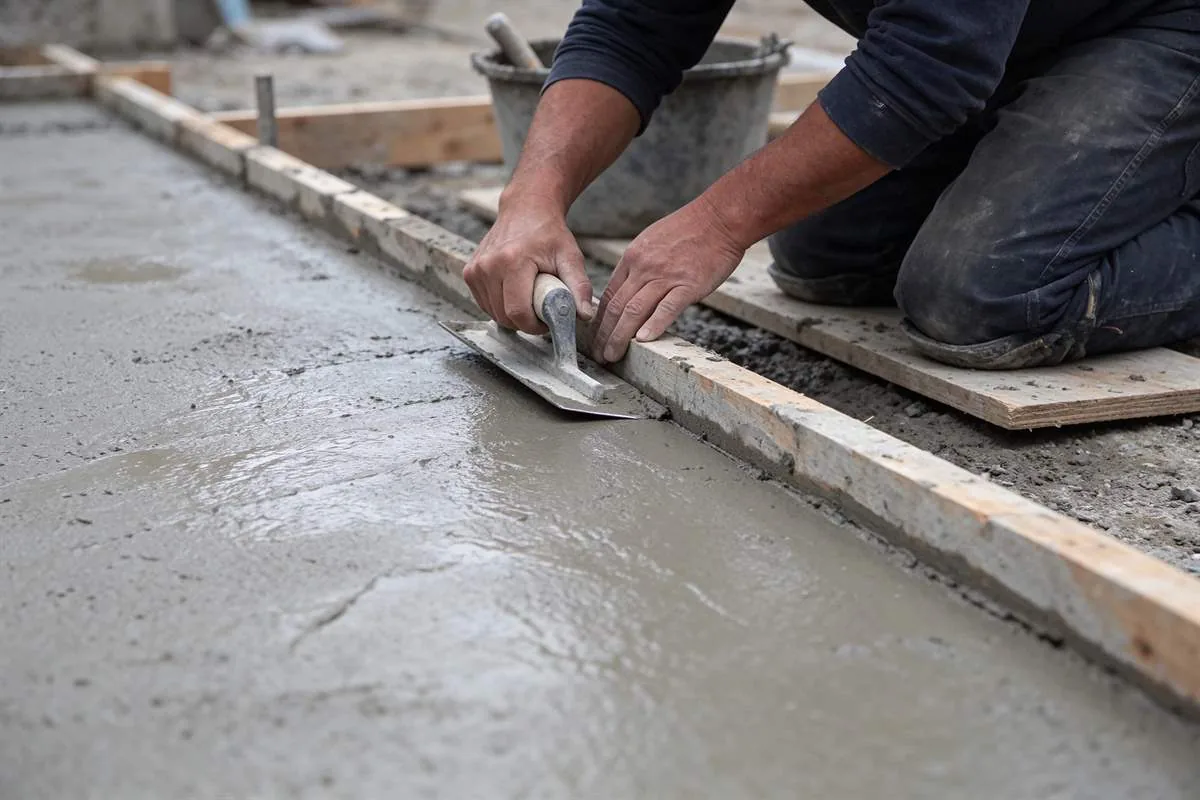
Three things follow. First, always ask for the total delivered price on your actual quantity, not the per-yard rate. Second, ask what the minimum is, because if it is 3 yards and you need 1.4, the answer is that you are buying 3 — unless another neighbour is pouring the same week, in which case two orders can share a truck and both get a better rate. Third, ask about the wait charge: the truck gives you a set time to unload, often 5 minutes per yard plus 15, and after that it bills by the hour. A slow wheelbarrow crew on a 1.5 yard pour can pay more for waiting than for the concrete.
Which is why, on small pours, the question is not "bags or truck" but "bags or truck or a helper". One person with 82 bags and a mixer will finish in six hours. Two people with a small mixer and a barrow finish in three, and the second person costs less than the short-load fee.
5. Add ten percent, and for a real reason
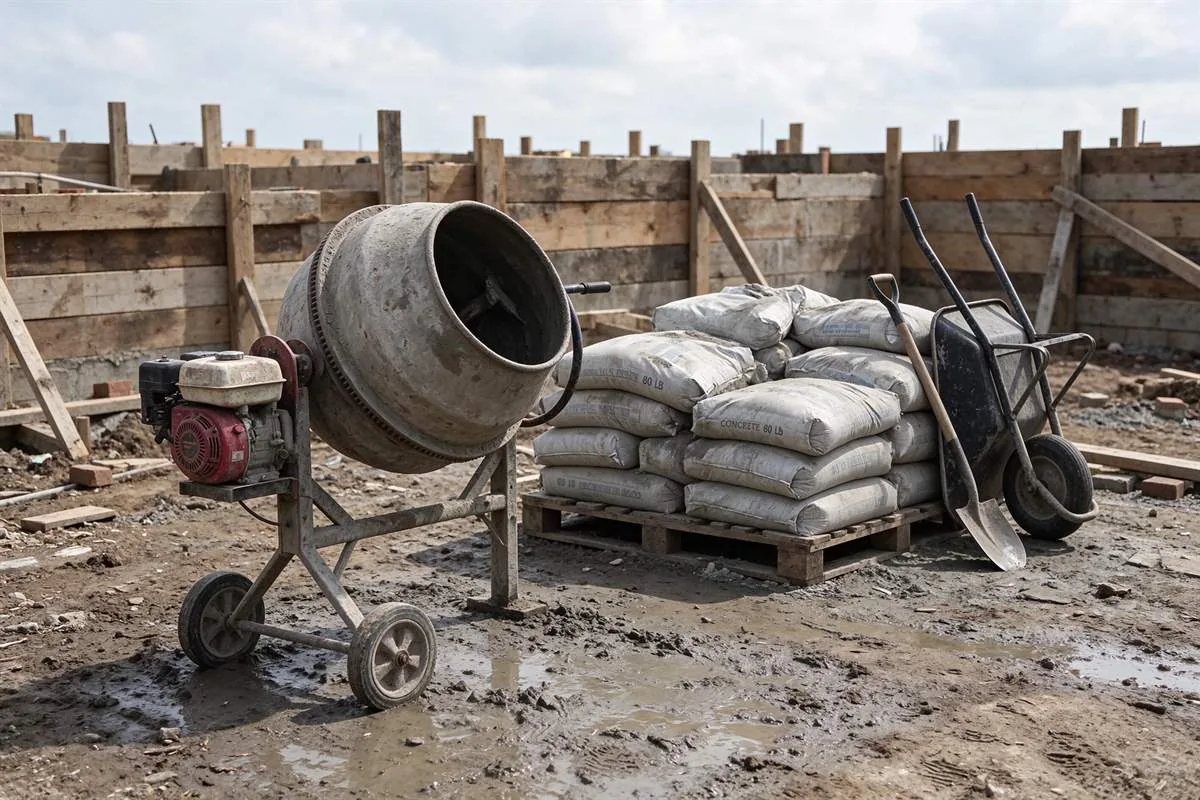
The 10 percent in the worked example is not a fudge factor. A subgrade is never perfectly level, and a slab poured on a low spot consumes concrete until it fills the dip. Formwork bows outward under the weight of wet concrete, adding a measurable amount of width at the bottom. And the last barrow always leaves some in the drum.
Ten percent is the right allowance for a slab on prepared ground. Twenty percent is closer for a first pour over rough soil, and for footings in wide trenches, where the trench is dug by hand and rarely the size the drawing says. Running out is not a recoverable error: the concrete that has already gone off will not bond to a fresh batch, and the joint between them is a permanent cold joint and a future crack.
The one place to not over-order is a truck, because you pay for what leaves the plant. Order 1.36 yards, and if the supplier rounds to 1.5, that is the correct answer — the 0.14 yards of surplus has to go somewhere, and a form board makes a good place to dump it.
6. The whole order, priced both ways
| Item | Quantity | Basis | Bag route | Truck route |
|---|---|---|---|---|
| Concrete | 1.36 cu yd | 10 x 10 at 4 in, plus 10% | $558 | $318 |
| Compacted base, 4 in | 1.23 cu yd | 100 sq ft of subbase | $47 | $47 |
| Mesh reinforcement | 100 sq ft | one roll | $45 | $45 |
| Formwork, 2x4 | 10 x 8 ft | 40 ft of perimeter | $80 | $80 |
| Total | $690 | $450 |
Two observations from that table. The concrete is 80 percent of the bag route and 70 percent of the truck route, so everything else is rounding. And the $240 difference between the two routes is almost exactly the cost of the base, the mesh and the forms — which means choosing bags on a pour this size pays for the entire supporting cast twice.
What the table does not include is time, and time is where the bag route really costs. Mixing and placing 82 bags is a full day with one person. The truck arrives, pours in twenty minutes, and the rest of the day is finishing and cleaning up, which you have to do either way.
7. The short version
Volume is length times width times thickness in feet, divided by 27 for cubic yards. Add 10 percent, more if the ground is rough. One cubic yard is 45 bags of 80 lb, 60 bags of 60 lb, or 90 bags of 40 lb, so the 80 lb bag is the cheapest concrete per yard if your back allows it.
Below about a cubic yard, bags win on price and lose on time. Above it the truck wins outright, and the deciding number is the short-load fee, which sits between $150 and $300 and is never in the quoted per-yard rate. Ask for the delivered total on your quantity, and ask what the minimum order is before you fall in love with a volume.
Then round up once, at the start. Running out mid-pour is the one error in this guide that cannot be corrected afterwards.