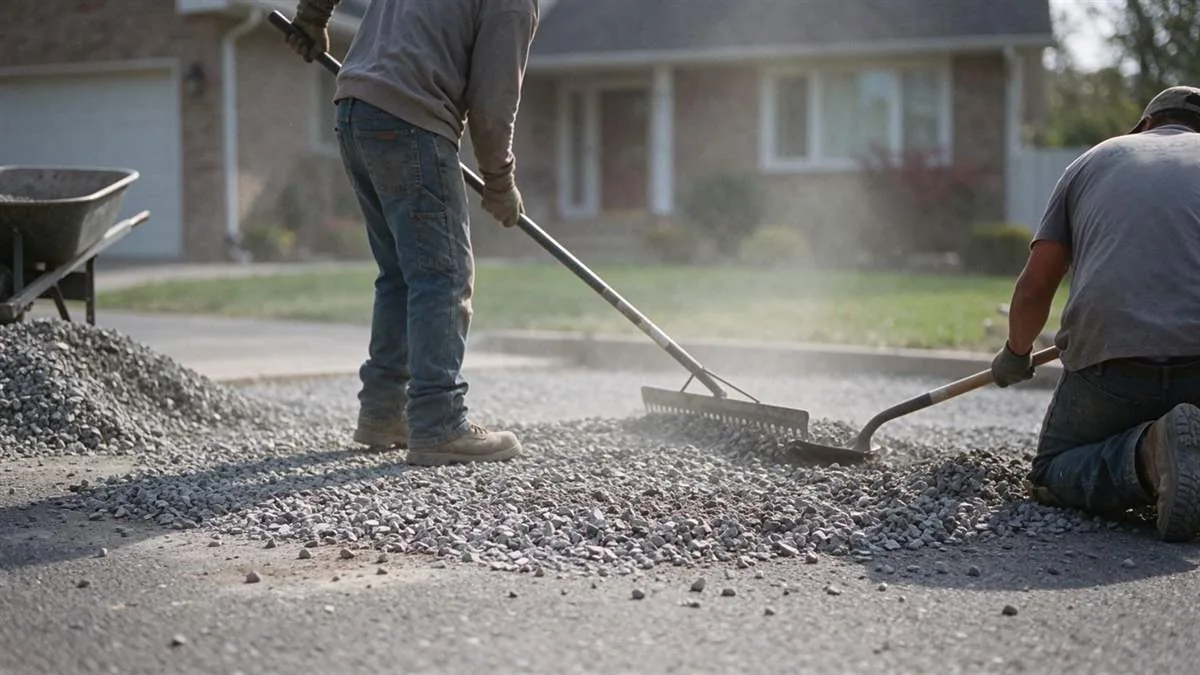
Gravel is the cheapest material in this series and the one people most often get wrong, because it is the only one sold by three units at once. A stone yard quotes you cubic yards. A bag quotes you cubic feet. A truck driver talks in tons. Those three are not interchangeable, and the gap between them is big enough to change what you order.
Start with the volume, because volume is what the job actually needs. Everything else is a conversion you have to survive.
1. The three numbers you need
Any gravel quantity comes from three inputs, and only one of them is a judgement call:
- Area — length times width, in square feet. For an irregular bed, split it into rectangles and add them.
- Depth — in inches, then divided by 12 to get feet. This is the number you choose, and the one most people choose badly.
- Density — how many tons a cubic yard of that particular stone weighs. Crushed stone runs about 1.35 tons per cubic yard loose; pea gravel and river rock run lighter, closer to 1.2.
Area times depth gives cubic feet. Divide by 27 and you have cubic yards, which is what the yard sells. Multiply cubic yards by the density and you have tons, which is what the truck weighs.
200 sq ft x 0.25 ft = 50 cubic feet. Divide by 27 = 1.85 cubic yards.
Add 10 percent for compaction and spillage = 2.04 cubic yards, which the yard will round to 2.5 because they sell in half-yard steps.
In bags that is 110 bags of 0.5 cubic feet. In weight it is 2.75 tons at 1.35 tons per yard.
Note the number that appeared in the middle: 1.85 cubic yards of loose stone becomes 2.04 because gravel settles. That 10 percent is not a fudge factor, it is the difference between a driveway that finishes level and one that needs a second trip.
2. Depth is the number you decide, and 3 inches is usually wrong
The default depth in almost every online gravel calculator is 3 inches, and for a driveway it is about an inch and a half too thin. Depth has to match what is underneath and what will drive on it:
| Application | Depth | 20 x 10 ft needs | Why |
|---|---|---|---|
| Decorative bed, mulch replacement | 1–2 in | 0.6–1.2 yd | Cover only, no load |
| Garden path, foot traffic | 2–3 in | 1.2–1.9 yd | Hands and barrows |
| Driveway over a prepared base | 3–4 in | 1.9–2.5 yd | Car tyres, one layer |
| Driveway over bare soil | 4–6 in | 2.5–3.7 yd | Base layer plus surface |
| Parking pad, occasional heavy vehicle | 6–8 in | 3.7–5.0 yd | Point loads |
The last row of that table is why 3 inches fails. A driveway over bare soil needs two layers: a base of larger crushed stone, 3 to 4 inches, compacted, and a surface of smaller stone on top. Ordered as a single 3 inch layer of one stone, the material simply sinks into the subgrade under the first wet season and you buy the difference again next spring.
Depth is also the most expensive mistake in the whole order, because cost scales linearly with it. Going from 3 inches to 5 inches on this driveway is 1.85 yards to 3.09 yards, which is about $77 of stone to about $117 — not fatal, but only if you got the first number right. Order 3 inches because a calculator said so, then discover you needed 5, and the second order carries a second delivery charge that is larger than the stone.
3. Yards, tons and bags are three different questions
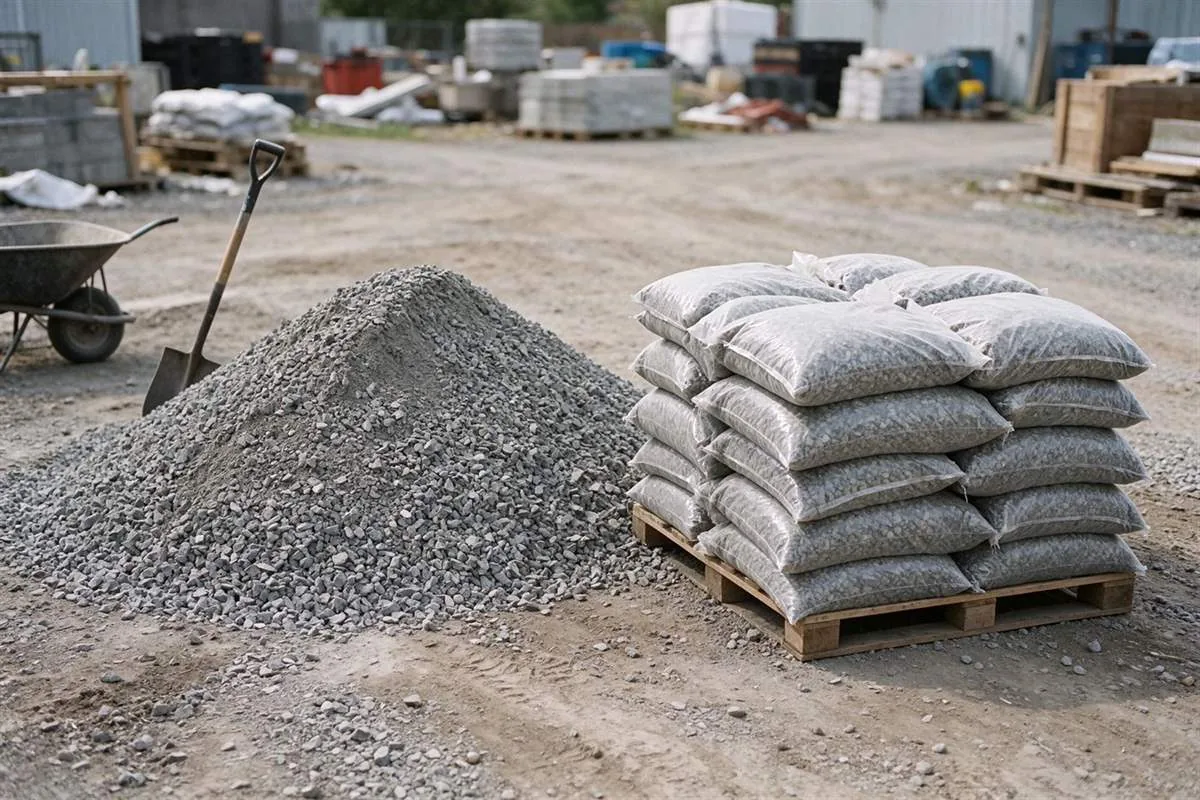
Here is the part that surprises people. A cubic yard of loose crushed stone weighs about 2,700 pounds. A bag of gravel sold as 0.5 cubic feet and 40 pounds implies a density of 80 pounds per cubic foot — about 2,160 pounds per cubic yard. That is 20 percent lighter than the same volume at the yard.
Both are honest. The bag is not lying about its volume and the yard is not lying about its weight. What differs is how the stone is packed: the yard's pile has been loaded and dropped and contains more fines and more contact between stones, while the bag is a loose scoop sealed at the factory. But the practical consequence is real: 54 bags make one cubic yard by volume and weigh 2,160 pounds, while one cubic yard from the yard weighs 2,700. If you plan a job in bags and then size a base for it, you have 20 percent less stone than the volume suggested.
The rule that avoids all of this: convert everything to cubic yards first, then compare prices in dollars per cubic yard. A bag at $5.50 for 0.5 cubic feet is $297 per cubic yard. Bulk stone at $38 per cubic yard is eight times cheaper before you have paid a single delivery fee.
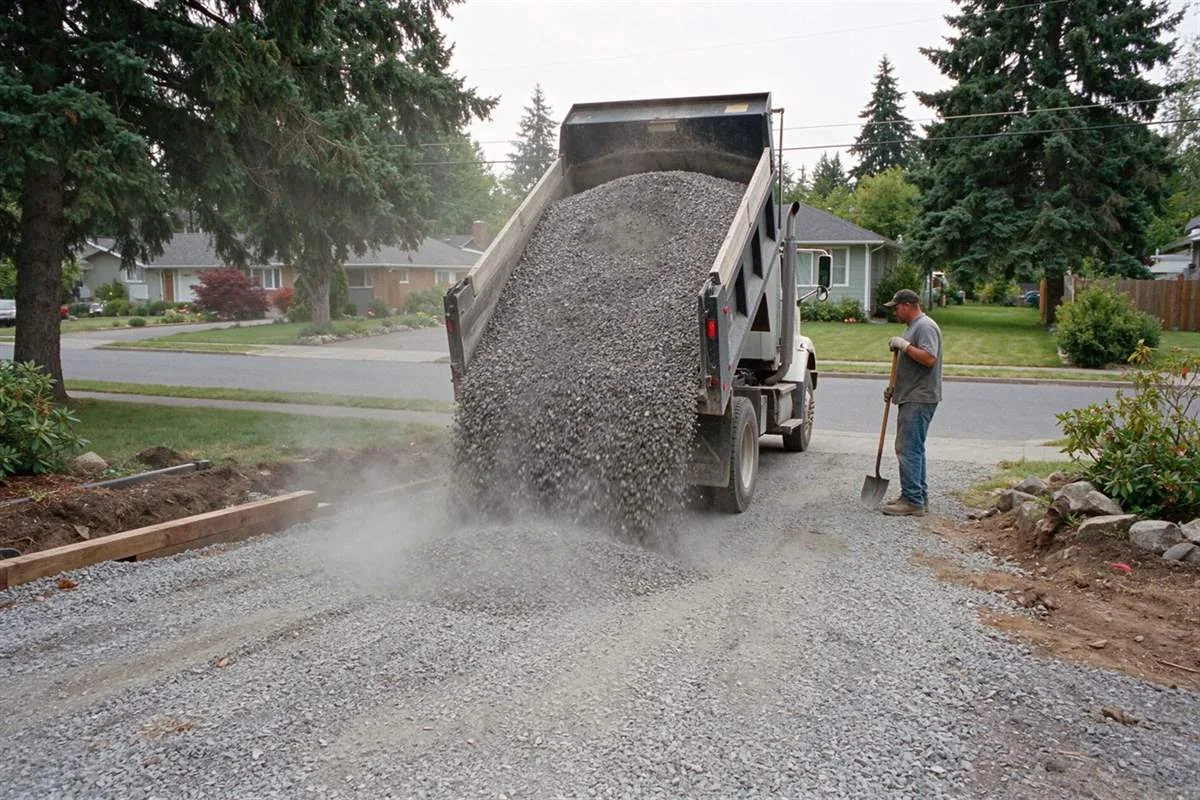
Weight matters when you are collecting it yourself, because that is where the vehicle becomes the constraint. 2.04 cubic yards of crushed stone is 2.75 tons. A half-ton pickup with a 1,000 pound payload cannot take a third of it. A 10 foot utility trailer rated at one ton needs three trips. Three trips at 40 minutes each is a two hour afternoon, which is the real cost of skipping the delivery.
4. Bulk or bagged: the break-even is lower than you think
The comparison people expect is a simple one, and the arithmetic is less friendly than the intuition. Take typical 2026 numbers: bulk crushed stone at $38 per cubic yard, a delivery charge of $95 on orders under 5 yards, and bagged stone at $5.50 for a 0.5 cubic foot bag, which is $297 per cubic yard.
That is ten cubic feet. Twenty bags. Below that quantity, bagged stone is genuinely cheaper, because the delivery charge is larger than the saving on the stone. Above it, the bulk price wins by a margin that grows fast: at 2.04 yards the difference on this driveway is $605 bagged against $190 bulk, delivered.
But break-even is not the same question as availability, and this is where real orders get decided. Many yards have a 5 cubic yard minimum for delivery, or charge the full delivery fee regardless of load size. So a job that needs 2 yards has three honest options:
| Option | What you pay | What you get | Catches |
|---|---|---|---|
| Bagged, 110 bags | $605 | exactly 2.04 yd | 110 trips to the car |
| Bulk, 2.5 yd delivered | $190 | 0.46 yd spare | minimum may force 5 yd |
| Bulk, collected yourself | $95 | 2.5 yd in 3 trips | two hours and a trailer |
Two things about that middle row. First, the yard sells in half-yard steps, so 2.04 becomes 2.5 — you pay for 0.46 yards you may not use, which is $17 and not worth arguing about. Second, if the minimum is 5 yards, buying 5 for a 2 yard job costs $190 in stone and leaves you a pile in the way for a year. In that case collect it yourself, or find a yard with no minimum.
Where bagged stone does win, legitimately: a single flower bed, a dry creek feature of 30 square feet, a repair where you need four bags and a car boot. And small quantities of a special stone — black Mexican beach pebble, white marble chip — are bagged-only, because no yard stocks them in bulk.
5. What the calculator cannot see: fabric, base and edge
Three items belong to the same job as the stone and are routinely forgotten, each of them priced on a different measure than the gravel itself.
Weed fabric goes under the stone, on the area, not on the volume. A 20 by 10 foot bed needs 200 square feet of fabric; a standard roll is 3 by 50 feet, or 150 square feet, so two rolls with 100 square feet spare. Fabric is what stops stone migrating down into the subgrade, and it is the reason a gravel path stays a path instead of becoming a line of buried pebbles within two seasons. Skip it over soil and you have bought stone that will be half gone in a year.
Edge restraint goes on the perimeter. A 20 by 10 foot area has 60 feet of edge. Timber edging in treated 2 by 4 comes in 8 foot lengths, so 60 feet is eight boards. Steel edging is sold by the linear foot and is about three times the price. Without an edge, a loose gravel surface spreads outward every time it is driven on, and the driveway you graded in April is two feet wider and one inch thinner by July.
Compaction is free but it changes the number you order. Loose stone settles roughly 10 to 15 percent under a plate compactor, and more than that if it is simply driven over. That is what the 10 percent allowance in the worked example is paying for. Lay it in two inch lifts rather than one deep layer: a 4 inch layer compacted from the top leaves the bottom four inches loose, and the surface will rut where the loose zone sits.
One more thing a calculator will never ask: drainage. Gravel over soil needs a fall of about 2 percent away from the building, which is a quarter inch per foot. On a 20 foot run that is 5 inches of height across the width. If the site is flat, the stone has to go somewhere, and if it cannot drain it becomes a puddle with stones in it.
6. The whole order, priced
| Item | Quantity | Basis | Cost |
|---|---|---|---|
| Crushed stone, 3/4 in | 2.5 cu yd | 2.04 rounded to half yards | $95 |
| Delivery | 1 load | flat fee under 5 yd | $95 |
| Weed fabric | 2 rolls | 200 sq ft of bed | $38 |
| Timber edging | 8 x 8 ft | 60 ft of perimeter | $56 |
| Materials total | $284 |
The stone is barely a third of that total. This is the pattern with gravel everywhere: the material is cheap, the logistics and the supporting items are not. Which also means the lever worth pulling is not the price per yard, it is whether you need a delivery at all.
7. What to ask the yard before you order
Five questions, and each of them changes the number you write down:
- Is that price per cubic yard or per ton? A quote of $38 that is actually per ton is $51 per yard at 1.35 tons, which is a third more than you thought.
- What is the minimum for delivery? Some yards deliver 1 yard, some want 5. This single answer decides whether bagged stone is rational for your job.
- Do you sell in half yards? If not, 2.04 yards becomes 3 and you have paid for a yard of air.
- Is it washed or crusher run? Crusher run includes stone dust and compacts to a hard, almost concrete-like surface — excellent as a base, poor for drainage. Washed stone is clean and drains, but will not bind.
- Where can the truck tip? A tandem load needs a clear drop zone. If the driver cannot get within 20 feet of the work, you are moving 2.75 tons with a barrow, and that is the afternoon gone.
The cheapest gravel mistake is ordering a yard too few. The most expensive is ordering a truckload you cannot get to the hole.
8. The short version
Multiply area by depth in feet, divide by 27, add 10 percent, and round up to the nearest half yard. Then convert: 1 cubic yard of crushed stone is about 1.35 tons or 54 bags. Choose depth by what is driving on it and what is underneath — 3 inches for a bed or a path over a base, 4 to 6 inches for a driveway over soil.
For anything above 0.4 cubic yards, price bulk with delivery before you price bags. For anything below, or for a stone no yard stocks, buy bags and skip the delivery charge.