1. A ceiling has one surface and no deductions
Ceiling area is the simplest number in the whole house, and that is exactly why people get the paint order wrong. A ceiling has no doors, no windows, no trim to deduct and no second face. A 12 × 20 room is 240 square feet of ceiling, full stop. Multiply the two dimensions and you are done.
What the simple number hides is that the ceiling is the one surface where the coat count is not optional. Walls get away with one coat over a similar colour. A ceiling almost never does.
| Room footprint | Ceiling area | At 350 sq ft per gallon, one coat |
|---|---|---|
| 10 × 12 | 120 sq ft | 0.34 gal |
| 12 × 20 | 240 sq ft | 0.69 gal |
| 12 × 20, two coats | 480 sq ft of work | 1.37 gal → buy 2 |
| 16 × 20 | 320 sq ft | 0.91 gal |
2. Multiply by the coats before you divide by the coverage
Ceiling paint covers about 350 square feet per gallon on a smooth, sealed surface — the same figure as wall paint, because it is the same chemistry in a flatter sheen. The number that matters is not 240, it is 240 × the number of coats.
Two coats on 240 square feet is 480 square feet of roller work. Divide by 350 and you get 1.37 gallons. Paint is sold in gallons and quarts, so 1.37 becomes two gallons, or one gallon plus two quarts if the store has quarts of the same base. Never buy 1.37 as "one gallon and a bit" — the bit is the coat that fails.
Three coats on the same ceiling is 720 square feet, or 2.06 gallons. That is where the arithmetic gets awkward: two gallons is short by about a quarter, and a third gallon is 30 percent waste. Two gallons plus one quart is the honest order.
3. Why a ceiling almost always needs two coats
Three things fight you on a ceiling that do not fight you on a wall.
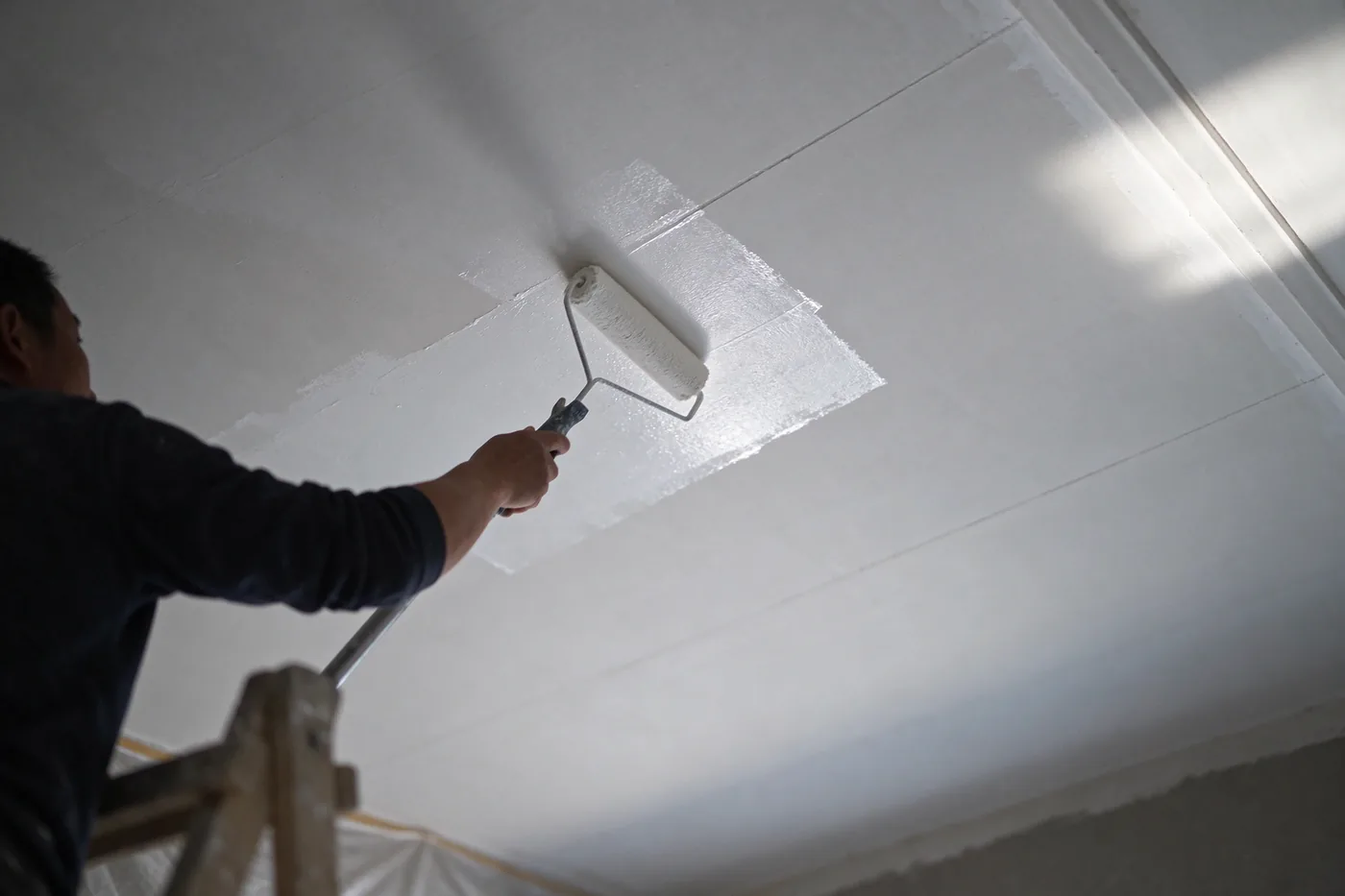
Light hits it flat on. A wall is lit at an angle and shading hides roller texture. A ceiling is lit from below and from the fixture inside it, so every lap mark, every thin patch and every skipped inch reads as a stripe. One coat shows all of it.
Ceiling white is a weak pigment. Titanium-white flat paint hides poorly over anything darker than itself. Painting a beige or greige ceiling white is not one coat over one coat; the first coat is a veil, and the second does the hiding.
Old ceilings yellow. Nicotine, cooking grease and 20 years of bulb heat leave a warm cast that comes back through a single thin coat within a season. If the ceiling has never been repainted, treat it as a colour change and budget three coats.
4. Ceiling paint is its own product
You can use wall paint on a ceiling and many people do. What you give up is spatter resistance and a truly flat finish. Ceiling paint is formulated thicker and flatter: it does not drip off the roller as readily, and the dead-flat sheen hides the unevenness that a satin or eggshell would throw back at you.
What you should not use is exterior paint, kitchen-and-bath semi-gloss or anything with a sheen above matte. On a ceiling, sheen is a defect detector.
| Finish | On a ceiling | Why |
|---|---|---|
| Flat / matte ceiling white | Standard | Hides lap marks, low spatter, cheapest per gallon |
| Eggshell | Rarely | Shows roller texture under downlight |
| Semi-gloss | Bathrooms only, small areas | Washable, but every flaw is visible |
| Exterior flat | Never indoors | Different binder, slow to stop off-gassing |
5. The band around the edge and the fixtures inside it
The roller cannot reach the last few inches at the wall, so you cut in a band by brush first. On a 12 × 20 ceiling the perimeter is 64 feet, and a 6 inch band is 32 square feet — 13 percent extra work that the flat 240 figure does not include.
Fixtures are a subtraction that nobody bothers with. A ceiling fan is about 2 square feet and a recessed light is a rounding error; leaving them in the count costs you nothing. Cutting around them, on the other hand, costs time: budget an extra 15 minutes per fixture for taping and edging.
If the room has crown moulding, it gets painted with the ceiling or with the wall, not both. Decide before you buy, because it changes the band width and, in a 12 × 20 room, roughly a quart of paint.
6. The order for a 12 × 20 ceiling, two coats
A plain 12 × 20 ceiling, currently off-white, two coats of flat ceiling white:
- 2 gallons flat ceiling white at about $32 — 480 square feet of work against 350 square feet per gallon
- 2 roller sleeves at $9, one per coat, because a loaded sleeve never gives a clean second coat
- 1 drop sheet and one roll of tape at $18, the ceiling is the surface that drips on everything below
- 1 extension pole at $22 — reusable, and the difference between 40 minutes and two hours on a ladder
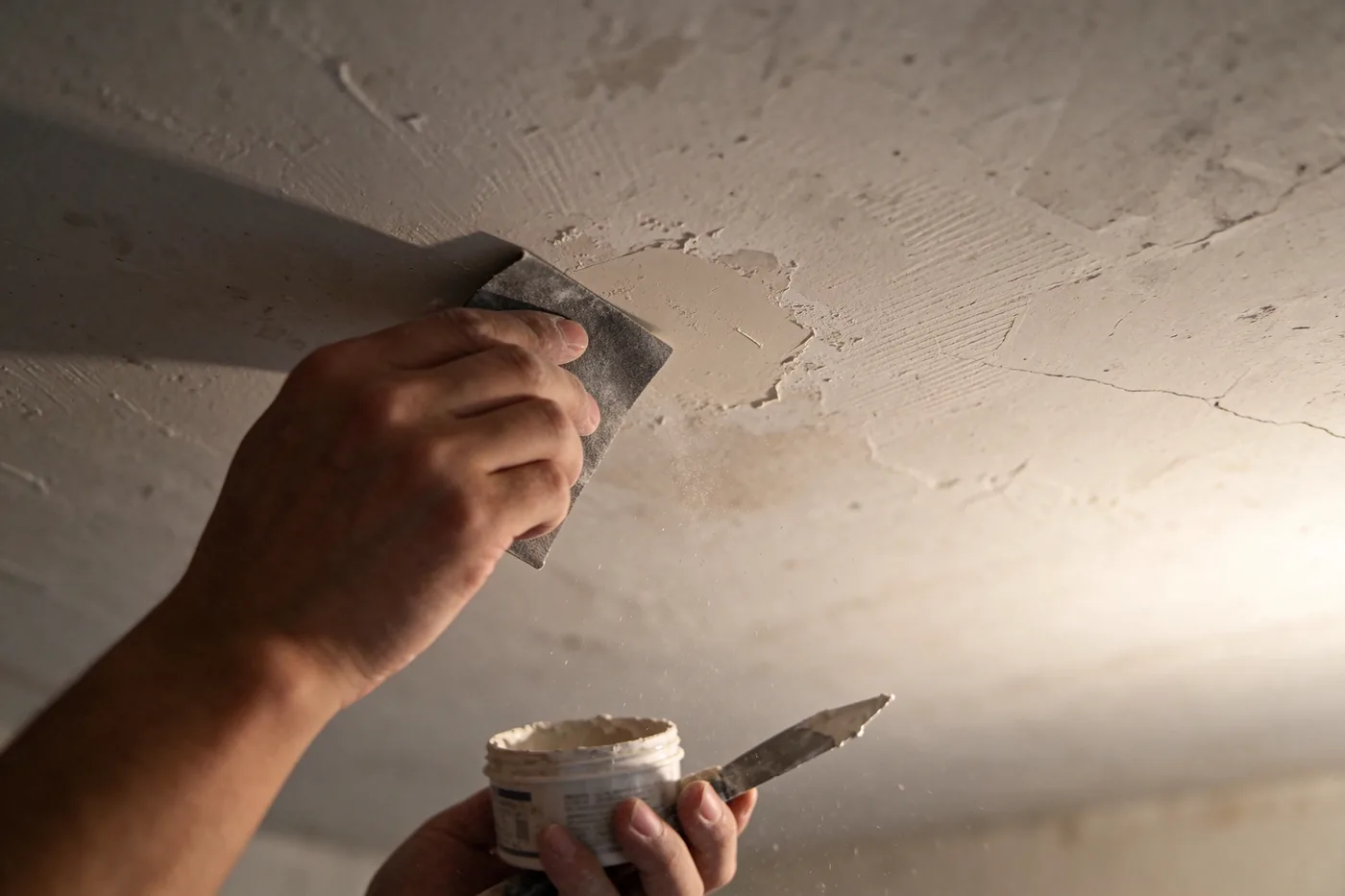
- Skip the primer unless the ceiling is stained, smoked or has never been painted
Materials come to about $97 without the pole, $119 with it. Add a gallon and a half of primer if the ceiling is a colour change, which is another $30 and one more coat of time.