1. One number does the whole conversion: 144
Tile is sold by the piece and priced by the square foot, so every order passes through the same conversion. Take the tile's width and height in inches, multiply them, and divide 144 — the number of square inches in a square foot — by that product.
A 12 × 12 tile is 144 square inches, so 144 ÷ 144 = 1 tile per square foot. A 6 × 6 is 36 square inches, so 144 ÷ 36 = 4 tiles per square foot. That is the entire method. The table below is just that division done twelve times.
| Tile size | Square inches | Tiles per sq ft | Sq ft per tile |
|---|---|---|---|
| 1 × 1 mosaic | 1 | 144 | 0.007 |
| 2 × 2 mosaic | 4 | 36 | 0.028 |
| 3 × 6 subway | 18 | 8 | 0.125 |
| 4 × 4 | 16 | 9 | 0.111 |
| 6 × 6 | 36 | 4 | 0.25 |
| 12 × 12 | 144 | 1 | 1.00 |
| 12 × 24 | 288 | 0.5 | 2.00 |
| 18 × 18 | 324 | 0.44 | 2.25 |
| 24 × 24 | 576 | 0.25 | 4.00 |
2. Read the table backwards when you are in the aisle
Nobody calculates while standing in a tile showroom. What you actually do is look at the box, read "10 pieces, 9.7 sq ft coverage" and decide whether that is enough. The backwards version of the table — square feet per tile — is what makes that possible.
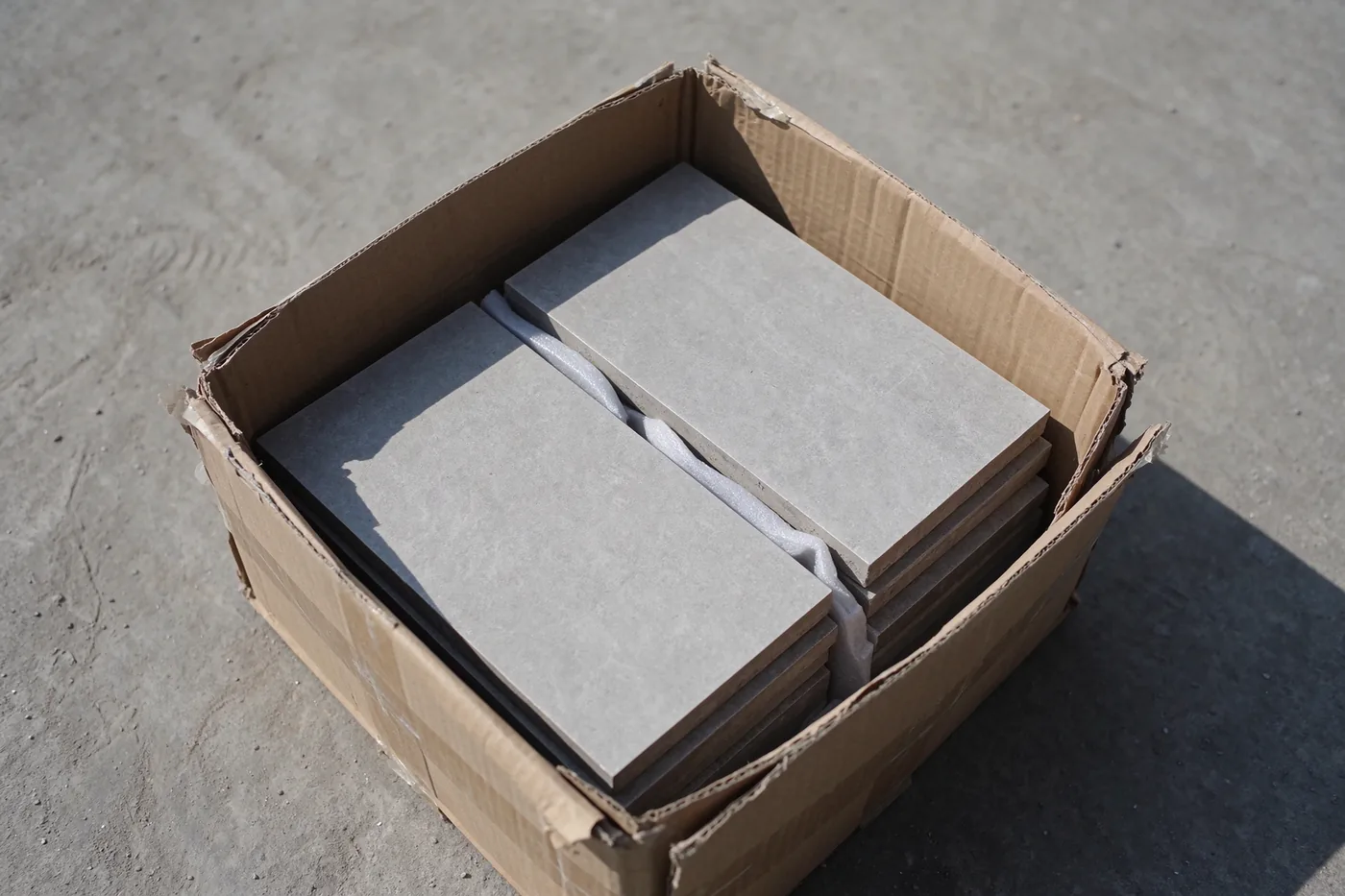
A box that covers 9.7 square feet and holds 10 pieces is a 12 × 12, because 10 tiles × 1 square foot is 9.7 with the box's own rounding. A box of 44 subway tiles claims 5.5 square feet: 44 × 0.125 is 5.5 exactly. When the two numbers on the carton disagree with the tile size, the carton is telling you the coverage is nominal, and you should order from the piece count, not from the coverage printed on the lid.
3. From square feet to cartons, with the 10 percent in the middle
Take a 10 × 8 bathroom: 80 square feet. On 12 × 12 tile that is 80 pieces, and the waste allowance is 10 percent — perimeter cuts, a broken piece, and the two spare tiles you want in the garage in five years. 80 × 1.1 = 88 pieces.
Cartons do the rounding for you. Ten pieces to a box means 88 tiles is nine boxes, 90 pieces, two spare. Buying eight boxes and hoping is the classic mistake: the last row of a 10 × 8 room is a cut row, and cut rows eat pieces.
| Job | Area | Tiles + 10% | Cartons |
|---|---|---|---|
| 10 × 8 bath floor, 12 × 12 | 80 sq ft | 88 | 9 boxes of 10 |
| 30 sq ft shower wall, 3 × 6 | 30 sq ft | 264 | 6 boxes of 44 |
| 200 sq ft floor, 24 × 24 | 200 sq ft | 55 | 14 boxes of 4 |
| 12 sq ft backsplash, 2 × 2 mosaic | 12 sq ft | 476 | sheets, not boxes |
4. Grout joints quietly change the count
The 144 rule measures tile, not tile plus grout. On a large format the grout line is noise. On a small tile it is a real percentage, and it works in your favour: a 1/8 inch joint on a 3 × 6 makes each module 3.125 × 6.125 = 19.14 square inches, so a square foot holds 7.5 tiles instead of 8.
Across a 30 square foot shower wall that is 226 tiles instead of 240 — six percent fewer. Order by the simple 144 rule and you over-buy slightly, which on subway tile is the safer error: matching dye lots is harder than returning one box.
5. Patterns that eat more than 10 percent
Waste is not one number. It is a function of how many pieces get cut, and patterns multiply cuts.
| Layout | Waste | What drives it |
|---|---|---|
| Straight grid, large tile | 10% | Perimeter cuts only |
| Diagonal / 45° | 15% | Every edge becomes a triangle cut |
| Herringbone | 20% | Offcut from one end rarely fits the next |
| Small mosaic on mesh | 5% | Sheets cut whole; pieces stay intact |
Herringbone is the one that catches professionals. The pattern needs a cut at both ends of every course, and the offcut is the wrong length for the next course, so the leftover pile grows faster than the floor does.
6. The shopping list, written the way a tiler writes it
For the 10 × 8 bathroom floor in 12 × 12 porcelain at $2.20 a square foot:
- 9 boxes — 88 tiles needed, 90 bought, two spares kept
- Thinset for 80 square feet: one 50 lb bag covers about 95 square feet at a 3/16 inch notch
- Grout: 10 lb of sanded grout covers roughly 60 to 90 square feet at a 1/8 inch joint on 12 × 12
- Spacers and a rubbing stone, cheap and the reason the joints stay even
- Buy all boxes in one trip — dye lot differences are visible across a bathroom floor and invisible on a single box
Tile comes to about $176 for 80 square feet at that price, plus $30 for thinset and $18 for grout. The difference between eight boxes and nine is $22, which is roughly the cost of one trip back to the store.