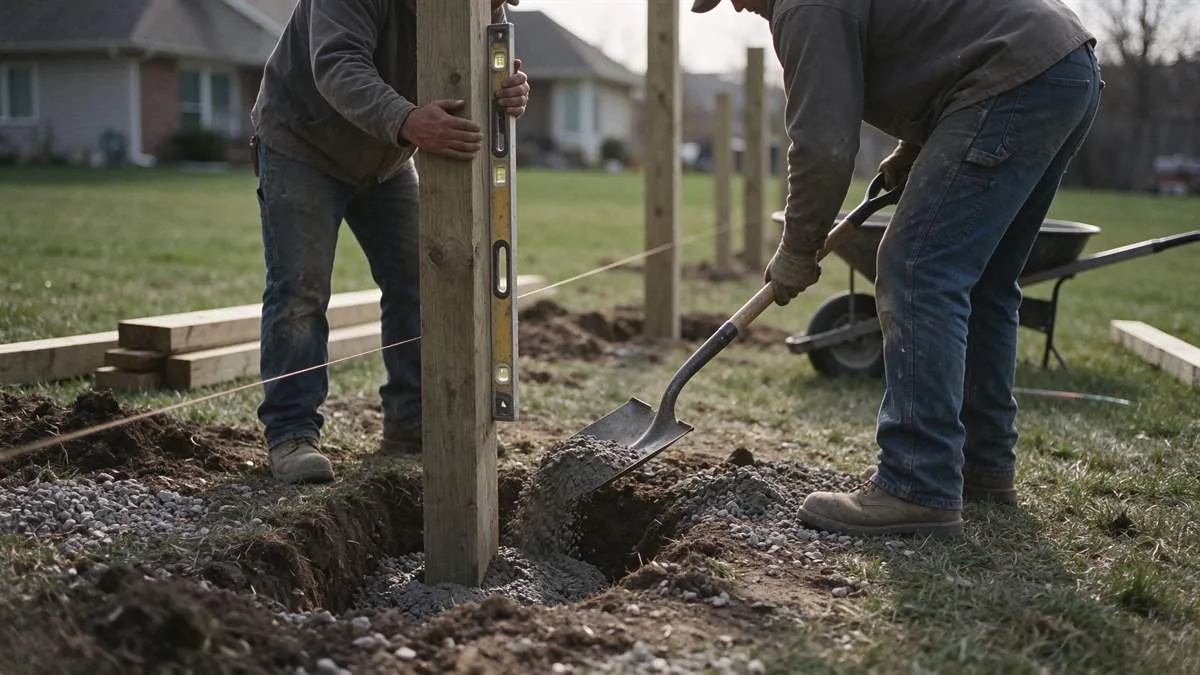
A fence is the one project in this series where the headline number is not the material you see. Nobody asks how many pickets they need; they ask how many posts, because posts are the part that has to be dug, set, levelled and waited on. Everything else hangs off that count.
And the post count is where the arithmetic gets quietly wrong. Not badly, but consistently, in the same direction, on almost every fence estimate you will find.
1. Posts: divide, then round, then add one
A hundred feet at 8 foot spacing sounds like 12.5 bays, and the instinct is to round to 12 and buy 13 posts. That is the wrong round. Here is why:
Every fence has a post at each end. So the number of posts is always one more than the number of bays, and the bays have to be a whole number. Twelve bays over 100 feet gives a spacing of 8.33 feet. Thirteen bays gives 7.69 feet. Eight foot spacing is a maximum, not a target — the rail span is what fails when you exceed it.
100 / 8 = 12.5 bays, which rounds up to 13 bays.
Posts = bays + 1 = 14 posts, and the real spacing becomes 100 / 13 = 7.69 ft.
One bay is given to a 4 ft gate, so 12 bays carry rails.
The difference between 12 and 13 bays is one post and about 8 inches of extra span per bay. On a 6 foot fence with 2 by 4 rails and a 5/8 inch picket, 8.33 feet is where rails start to sag visibly after two seasons — and a sagging rail is not a cosmetic problem, it is the pickets slowly pulling loose from the nails.
Two exceptions to the 8 foot rule. First, if the fence sits on a slope, bays on the steep sections should be shortened, because a rail that runs level across a fall needs to be longer than the horizontal distance. Second, if the fence will carry a wind load — an exposed site, a solid board fence over 6 feet tall — 6 foot bays are common. Both push the post count up, and both are decisions made before you order.
2. Rails: the 8 foot versus 16 foot question
Twelve bays need two rails each, so 24 rail pieces. Here is the comparison that every fence calculator skips, priced at retail:
| 8 ft 2x4 | 16 ft 2x4 | |
|---|---|---|
| Pieces to buy | 24 | 12 |
| Price each | $9 | $17 |
| Total | $216 | $204 |
| Offcut | none | none, if bays are 8 ft |
| How it meets the posts | ends at every post | spans the post between bays |
| Weight per piece | about 10 lb | about 20 lb |
Twelve dollars. That is the entire saving, on a fence that costs $879. And the 16 foot rail buys you a problem: a 16 foot rail laid across two 8 foot bays has to pass the middle post, and there are only two ways to do that. You can notch the post — cut a housing into it so the rail sits inside — which removes a third of the post's cross section at exactly the height where the fence takes its load. Or you can nail the rail to the face of the post and let it run past, which means the joints are no longer at the posts and the fence racks sideways under any push.
A 16 foot rail also needs two people to place and hold while it is fastened, and it is the piece most likely to arrive bowed. If it is bowed, you cannot straighten it by nailing — you will simply build the bow into the fence, bay after bay, because each new rail follows the one before it.
So the honest rule: 16 foot rails belong on a fence whose posts are already 16 feet apart. On an 8 foot layout they are a $12 saving that costs a helper, a notch and a straighter eye. Buy 8 foot rails and put the joints where the posts are, which is where a fence has always wanted them.
There is one place where the long rail genuinely wins: a run of more than about 60 bays on flat ground with no gate, where the labour of handling twice as many pieces starts to matter more than the notching. That is a farm fence, not a backyard fence.

3. Pickets count from width, not from area
This is where the arithmetic differs most from the other guides. You do not calculate pickets from square footage, because pickets are vertical boards placed side by side along a line. The count comes from the length of the run divided by the width of a board:
The 96 feet is 100 feet of fence minus the 4 foot gate bay, because nobody boards a gate opening. At a 3.5 inch dog-ear picket nailed tight, that is 330 boards.
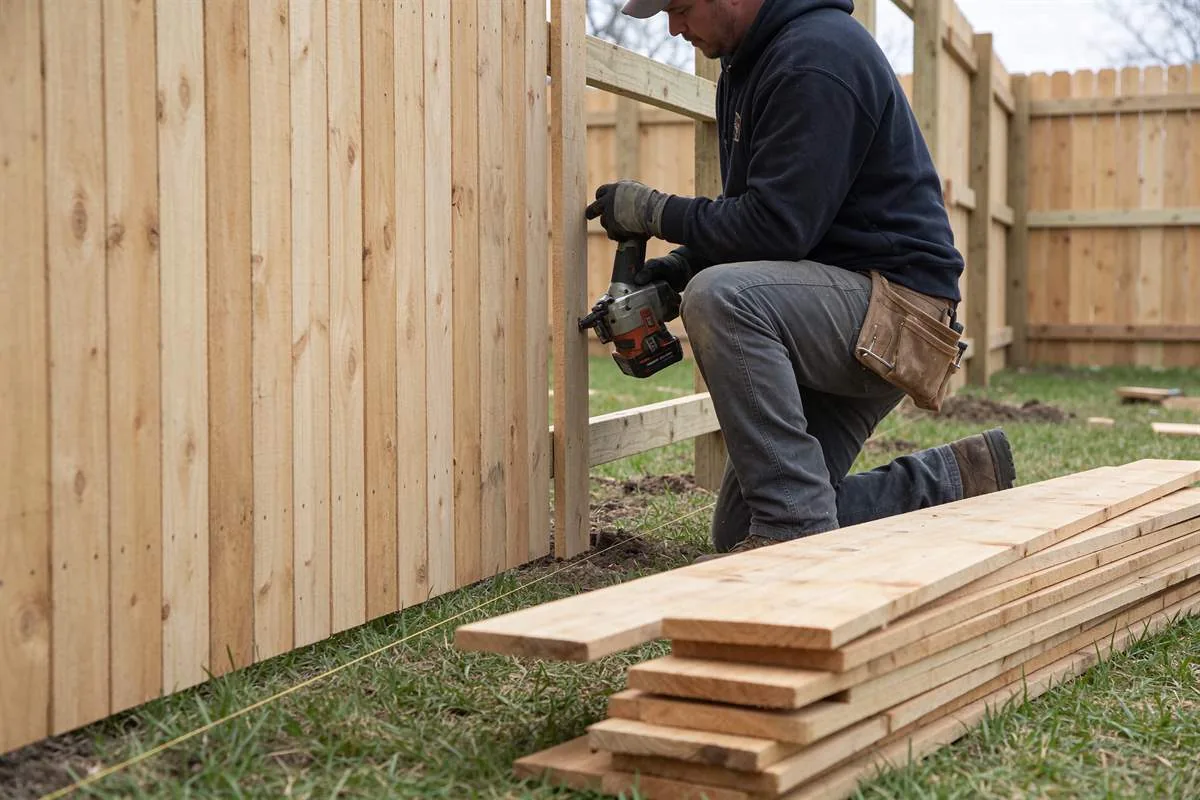
Now the choice that changes that number: leave a gap or close it up. A quarter inch gap between pickets gives 3.75 inches of effective pitch and drops the count to 307 — 23 fewer boards, about $23. In exchange, the fence stops being private, and it lets wind through, which is a genuine structural benefit on an exposed site.
Boards also need room to move. A 5/8 inch picket will swell by a measurable amount in a wet spring, and a fence nailed dead tight in July will have boards touching and lifting by April. Nailing each picket to the top rail only — not both — lets the board move without splitting, and it is the single most useful assembly detail in an ordinary wooden fence.
4. Concrete: one bag per post, two for the gate
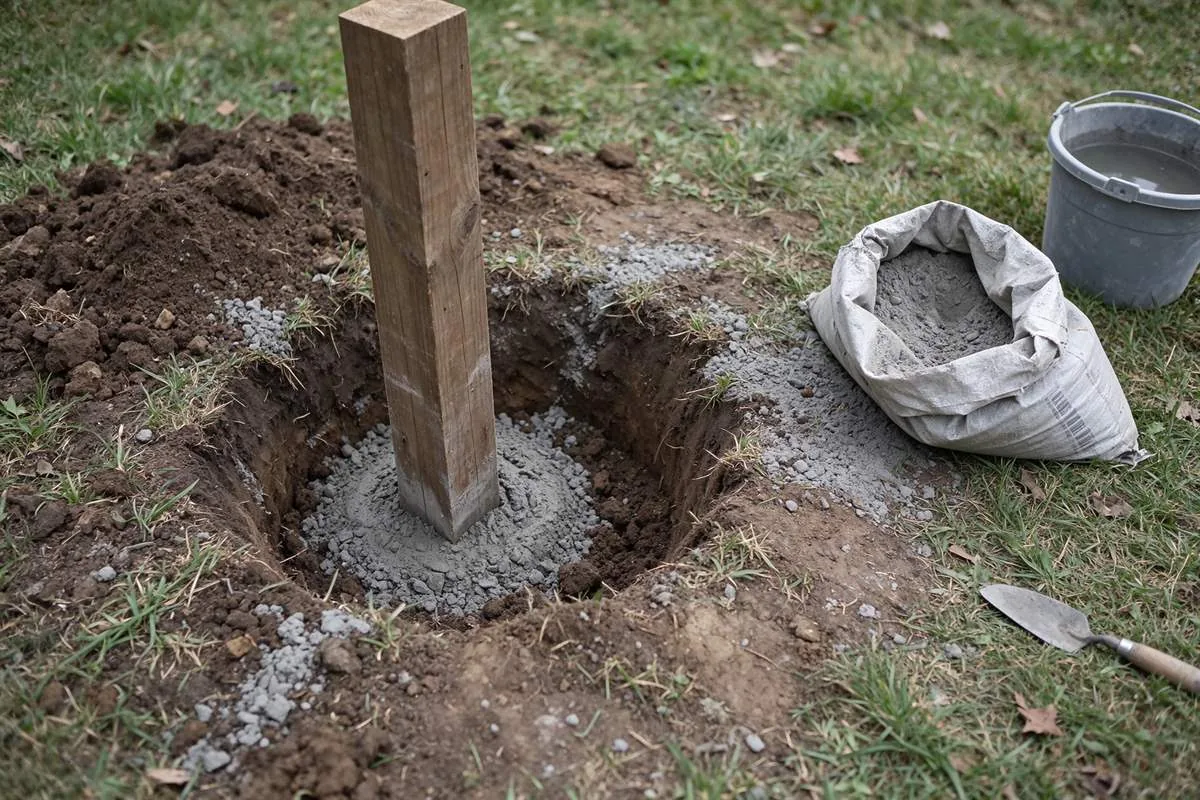
An 8 inch hole 24 inches deep holds about 0.70 cubic feet. A 50 lb bag of fast-setting mix yields about 0.375 cubic feet, so strictly the hole wants almost two bags. In practice one bag per post is the working standard, because the mix does not have to fill the hole — it only has to surround the base and lock it, with soil backfilled above.
Fourteen posts at one bag each, plus one extra bag each for the two gate posts, is 16. Order 19 and you will not run short on a hole that turns out wider than expected, which at least one hole always does.
Two things matter more than the bag count. The first is depth: bury a third of the post, so a 6 foot fence above ground uses an 8 foot post with 2 feet in the ground — and go below the local frost line where there is one, because frost heave lifts a shallow post a fraction of an inch every winter until the fence is visibly out of level. The second is drainage: a post set in a hole that holds water rots from the bottom in about eight years regardless of treatment, so put a few inches of gravel in the bottom of each hole before the post goes in.
The dry-pour method — dropping the dry mix into the hole and pouring water on top — works and is faster. It is also less predictable, because the water does not always reach the mix at the bottom. If you use it, pour the water in two passes and give it ten minutes in between.
5. The gate bay is the most expensive bay you will build
One bay of the thirteen is 4 feet wide and takes the gate. It uses fewer pickets and no rails, which makes it look cheaper on paper. It is not:
- Both gate posts carry the whole gate, hanging. A 4 foot gate is 50 to 70 pounds swinging on two hinges, and a 4 by 4 post set in 24 inches of soil will lean toward the gate within a year. Gate posts are 4 by 6, or they are doubled, or they are set 30 inches deep. All three are correct; one of them is necessary.
- The gate needs a frame plus a diagonal brace if you are building it, and that is two more rails, two stiles and a brace that costs about the same as the rails you saved by not boarding the bay.
- The gate and its posts are the parts people service. Hinges, latch, self-closer and the sag that comes with them. Every call-out to a leaning gate over the next decade traces back to how those two posts were set on the first day.
Which is why the rail count is 24 and not 26: the gate bay carries no rails, but the two bays either side of it are doing more work than a bay with a gate would. If you have a choice, put the gate at a corner rather than mid-run, so one of the two gate posts is braced by the return leg of the fence.
6. The whole order, priced
| Item | Quantity | Basis | Cost |
|---|---|---|---|
| 4x4x8 posts | 14 | 13 bays + 1 | $168 |
| 2x4x8 rails | 24 | 12 bays x 2 rows | $216 |
| 5/8 in dog-ear pickets | 330 | 96 ft of run at 3.5 in | $330 |
| 50 lb fast-set concrete | 19 bags | 1 per post, 2 per gate post | $165 |
| Materials total | $879 |
That total excludes the gate, which is $120 to $200 bought as a kit, and excludes nails: about 5 lb of galvanised ring-shank nails for 330 pickets and 24 rails, which is $15 and the only fastener that matters. Ring-shank, not smooth, because a smooth nail in green treated lumber works loose in two seasons and the pickets start to rattle.
Add the tools you may not own — a post hole digger at $40, a 4 foot level at $25, a string line at $8 — and the real first fence costs about $1,050. The second one costs $879, because the tools are already in the shed, and that is the honest reason people who have built one fence build another.
7. The short version
Divide the run by the maximum spacing, round up to get bays, add one to get posts. Shorten the bays rather than exceed the spacing. Multiply bays by two for rails, and subtract the gate bay. Multiply the boarded run in inches by the picket width for board count. One bag of concrete per post, two per gate post, and bury a third of the post.
Buy 8 foot rails on an 8 foot layout and accept the $12. Put the joints at the posts, nail pickets to the top rail only, and use ring-shank nails. The gate is the part that will need attention first, so spend the attention on its two posts now.