1. The area gives you a number. The wall gives you the board count.
Start where every other calculator starts. A 12 by 10 foot room with 8 foot ceilings has four walls totalling 44 feet of perimeter, so the wall area is 2 x (12 + 10) x 8 = 352 square feet. Add the ceiling, 12 x 10 = 120, and the surface to cover is 472 square feet.
Divide that by the 32 square feet in a 4 by 8 sheet and you get 14.75, which rounds to 15 boards. Buy fifteen and you will run out before the ceiling is finished. The correct count for this room in 4 by 8 board is 17.
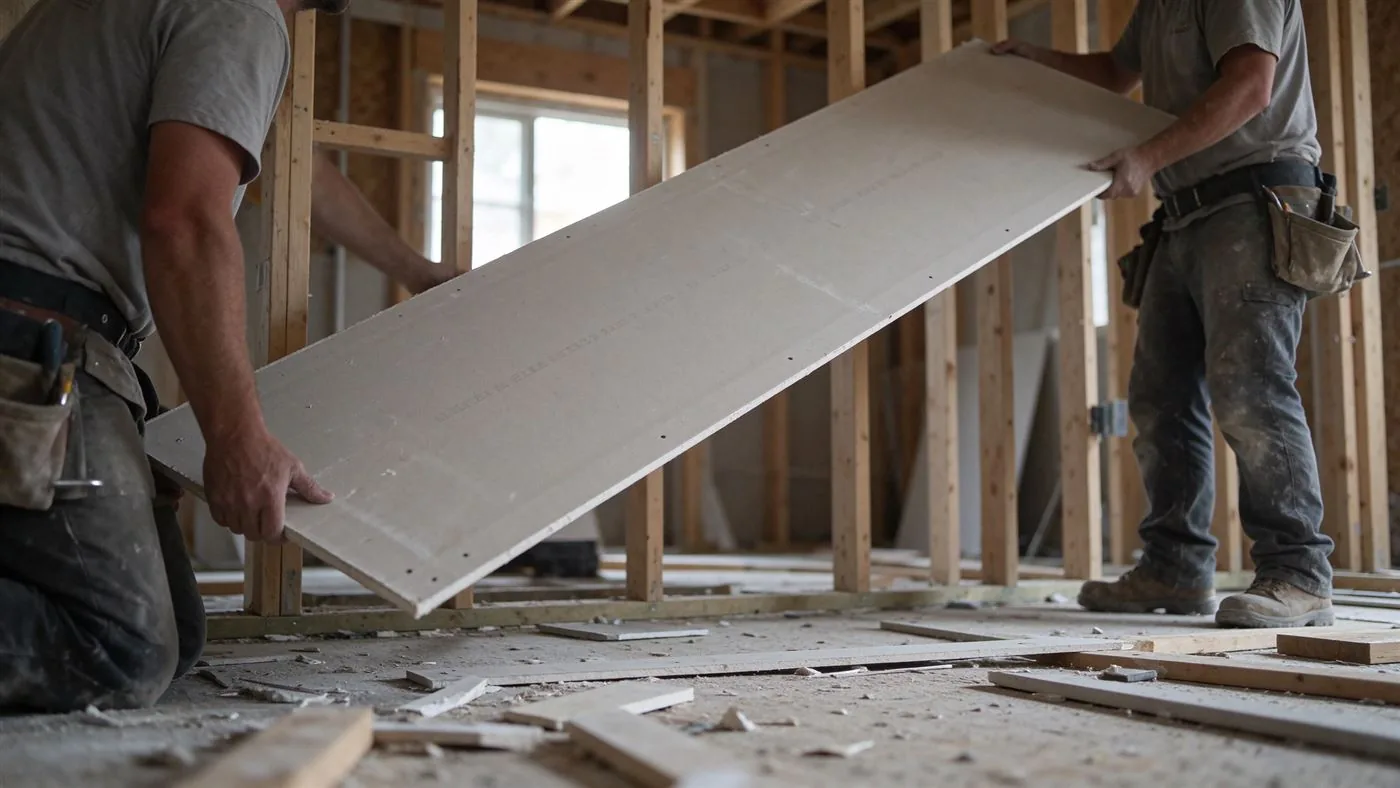
The missing two boards are not waste in the loose sense. They exist because a board cannot be stretched: a 4 foot wide sheet covers 4 feet of wall height, so an 8 foot wall is exactly two courses, and any wall longer than the board has to be pieced with a joint. The 10 foot walls are the problem — an 8 foot board leaves a 2 foot strip that is too short to use anywhere, on both courses, on both of those walls.
Why 15 is wrong: area divided by sheet size assumes every board is used whole. Boards are cut to fit wall height, and the offcuts from a 10 foot wall cannot be joined into anything. The board count is a layout result, not a division result.
2. Board length is chosen by wall height, not by area
Drywall sheets are always 4 feet wide in the other direction — 4 by 8, 4 by 10, 4 by 12. The 4 is fixed: it is the width you can handle and the number the stud spacing is designed around. The second number is the one you get to choose, and it has nothing to do with how big the room is.
What it does is decide how many pieces each course needs. On an 8 foot wall there are two courses of 4 feet. A 12 foot wall in 8 foot boards needs a full board plus a 4 foot piece. In 10 foot boards it needs a full board plus a 2 foot piece. In 12 foot boards it needs exactly one board and nothing else.
That is why the answer to "how many sheets" changes when you change the sheet and not the room. Same walls, same square footage, three different shopping lists.
3. The same room in three board lengths
| Board | Boards | Offcut | Joint to tape | Total, all materials |
|---|---|---|---|---|
| 4 x 8 ft | 17 | 8 sq ft | 164 ft | $297 |
| 4 x 10 ft | 14 | 8 sq ft | 160 ft | $286 |
| 4 x 12 ft | 12 | 56 sq ft | 148 ft | $288 |
Three boards fewer, eleven dollars cheaper, and the same amount of offcut. The 10 foot board wins on this room because two of the four walls are exactly 10 feet: one board, no cut, no short strip left behind.
And the 12 foot board loses despite needing the fewest boards of all. It cuts the joint length down to 148 feet, which is genuinely better for the finisher, but a 12 foot board on a 10 foot wall leaves a 2 foot by 4 foot strip on every course of both walls — 56 square feet of board nobody can use, and 12 foot sheets cost $20 each against $14 for the 8 foot.
The lesson is not "buy 10 foot board." It is that board length should be picked against the wall lengths in the room, and that means measuring the walls individually rather than trusting a perimeter total. A room with 12 foot and 14 foot walls will pick a different winner, and the calculator will say so.
4. Where 164 feet of joint comes from
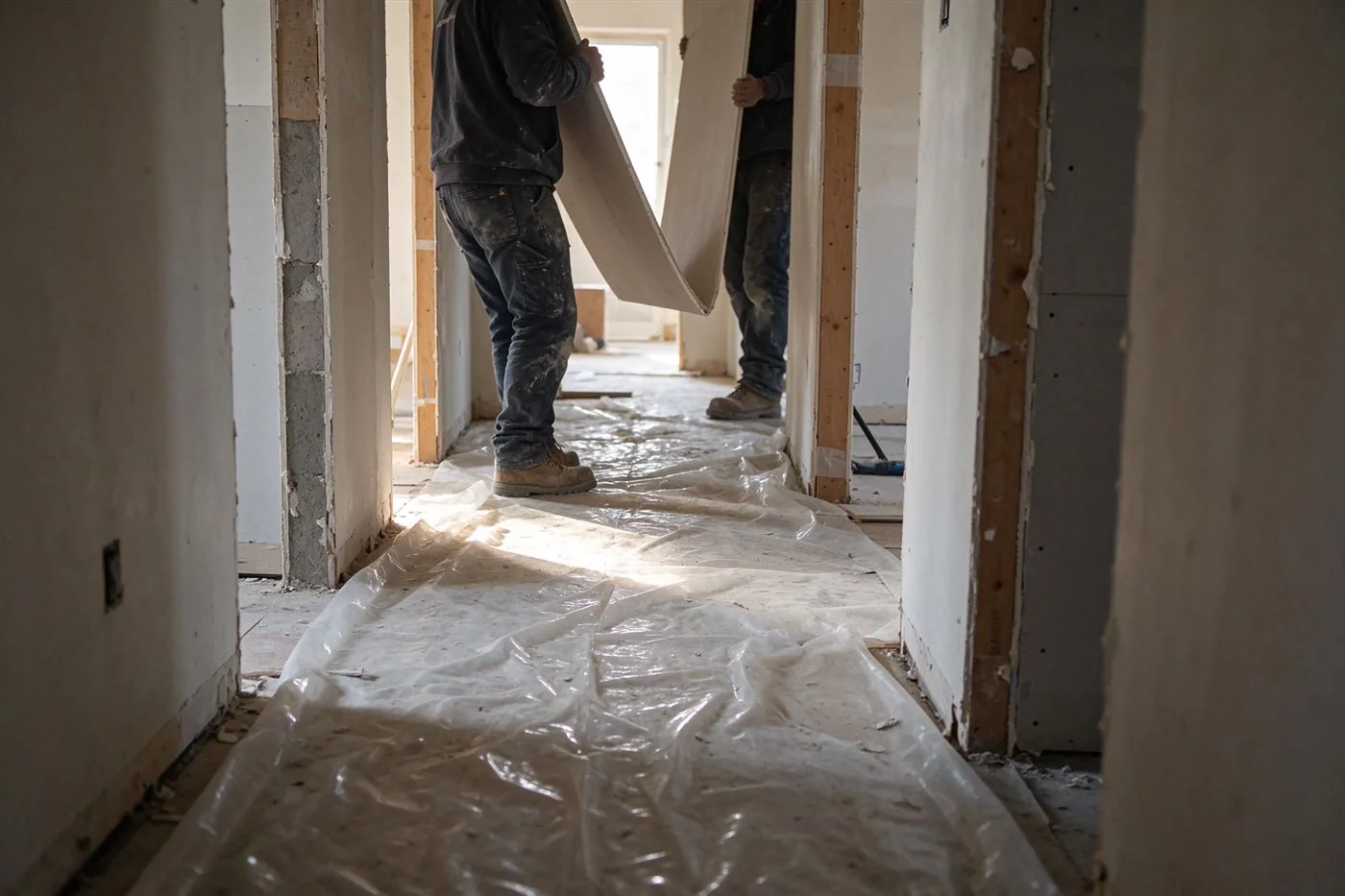
Joint compound is the second-largest line on the receipt, and it is priced by joint length, not by wall area. So it is worth seeing where the tape actually goes on this room:
| Source | Arithmetic | Feet |
|---|---|---|
| Four inside corners | 4 x 8 ft wall height | 32 |
| Horizontal joint between courses | one per wall: 12 + 12 + 10 + 10 | 44 |
| Vertical joints where boards meet | the 2 ft and 4 ft strips on the 10 ft walls | 32 |
| Ceiling | perimeter 44 ft + 3 seams x 4 ft | 56 |
| Total to tape | 164 |
Two observations that change how you plan the job. First, the ceiling is a third of all the joint in the room, on a surface that is the least pleasant to work overhead. Second, corners are not free: an inside corner is a joint you have to tape and coat twice, and a room with more corners has more mud per square foot even though its area is unchanged.
It also explains the appeal of the 12 foot board. Cutting the joint from 164 to 148 feet is a real reduction in work at eye level and overhead — it just is not enough to pay for 56 square feet of wasted board.
5. Mud is a tax on joints, not on area
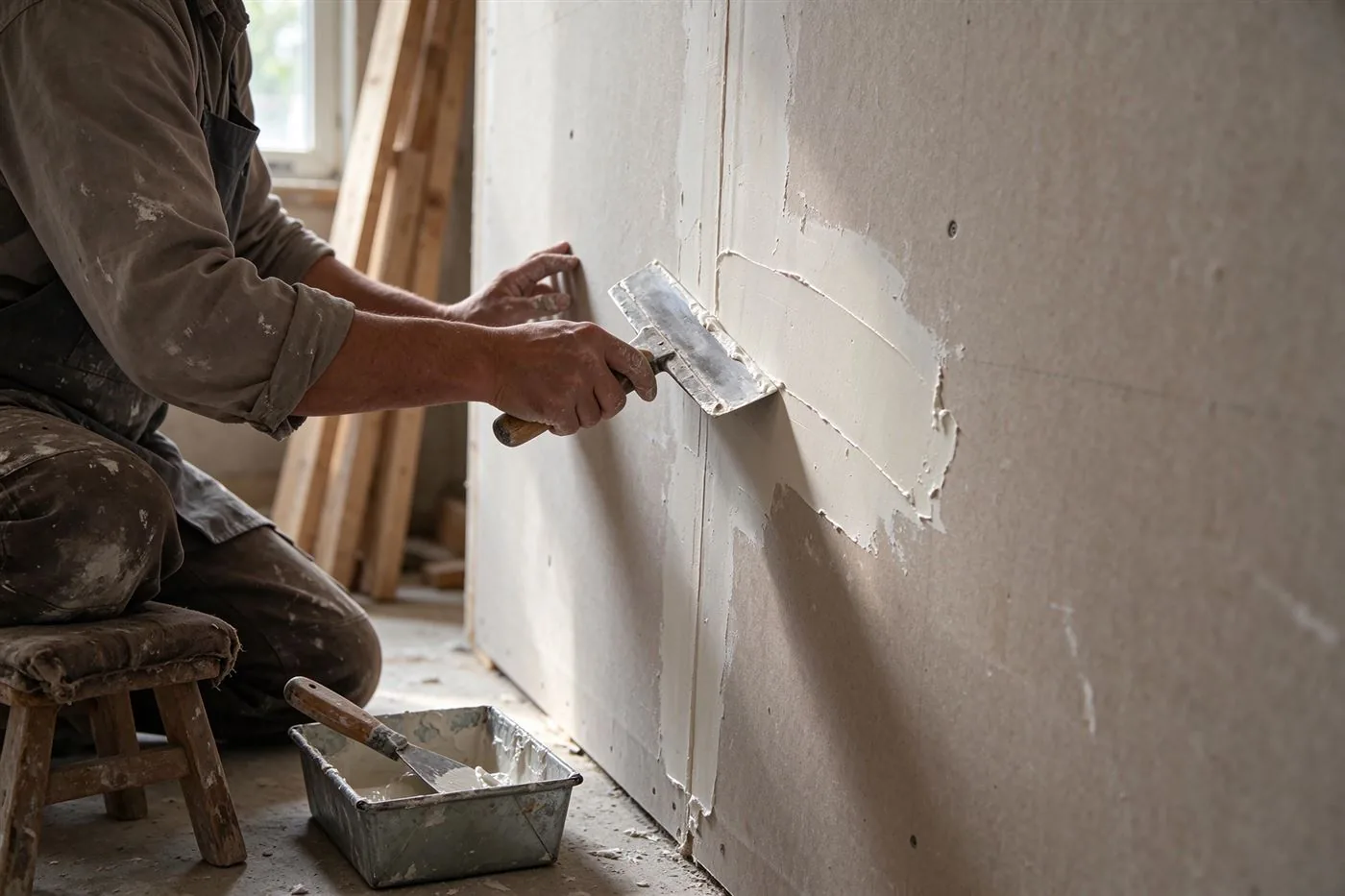
The count that matters is pounds of compound, and it comes from three coats over the tape plus a skim over the field:
- Over tape: about 0.14 lb per foot of joint — 164 ft gives 23 lb
- Over the field: about 0.01 lb per square foot — 472 sq ft gives 4.7 lb
- Total: 27.7 lb, which is one 5-gallon pail of ready-mix at 58 lb
Note how lopsided that is. The 23 lb over the tape is five times the 4.7 lb skimmed over the field. Adding ten square feet of wall barely moves the mud number; adding ten feet of joint moves it by nearly a pound and a half.
That is why a long narrow room and a square room of the same area do not need the same amount of compound, and why "one pail per 500 square feet" is a rough rule that breaks on rooms with a lot of corners, soffits and closets. A 30 by 30 room has four times the area of this one but only about twice the perimeter joint.
Buying advice follows directly: one pail covers this room with about 30 lb spare, and a second pail is $19 of compound that will skim over before you need it. Buy the second one only if the joint total is over roughly 350 feet.
6. Screws follow the board count, not the area
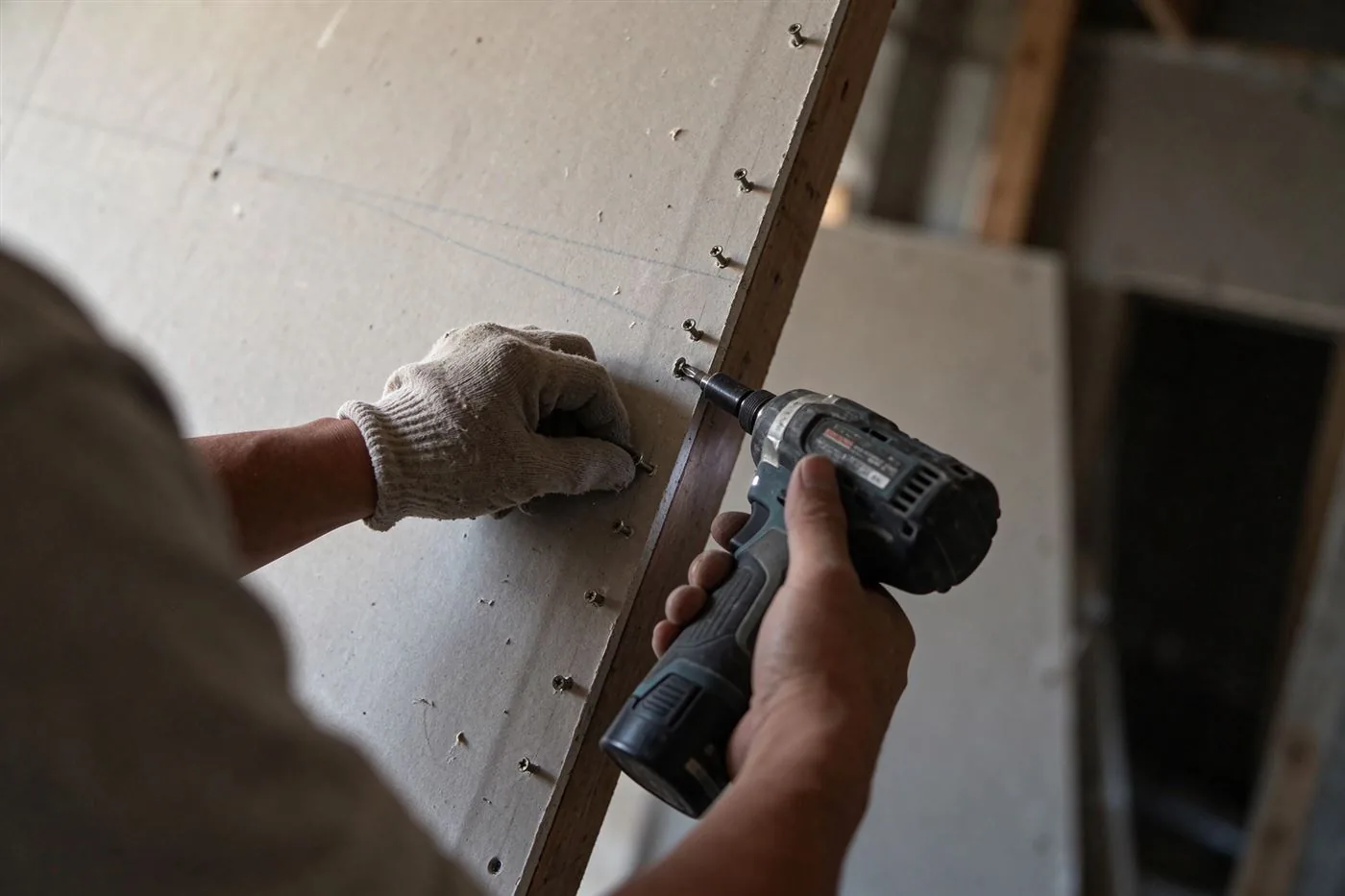
Screws are counted per sheet, and the sheet count is the number from section 3. At 16 inch stud spacing a 4 by 8 board takes about 32 screws; at 24 inch spacing, about 24. With a 10 percent allowance for the ones you bury too deep:
17 boards x 32 screws x 1.1 = 599 screws, which is three 1 lb boxes of 250. Move the studs to 24 inches and the same room drops to about 449 screws and two boxes.
This is the second place where fewer, longer boards pays twice. Fourteen boards instead of seventeen is not just three fewer boards to lift — it is roughly a hundred fewer screws to drive and a shorter joint to finish. The board saving is the visible one; the labour saving is the one that matters.
7. The ceiling is its own small job
120 square feet of ceiling in 4 by 8 board is 3.75 sheets, so 4 boards, and 8 square feet of offcut. That is a fifth of the board for the room and more than a third of the joint, which is why it deserves its own line on the shopping list rather than being folded into the wall total.
Two things go wrong here more often than anywhere else. Ceiling board is usually hung first, before the walls, so the wall boards can support its edges — if you buy exactly the wall count and start at the walls, you will be short. And ceiling joints are the ones that show: they are lit from below at a shallow angle, which exaggerates every ridge left by a hurried coat of mud.
8. The rest of the shopping list
| Item | For this room | Why that amount |
|---|---|---|
| Drywall, 4 x 8 | 17 boards | 14 wall and ceiling + 2 for the 10 ft walls' short strips + spare |
| Joint compound | 1 x 5 gal pail | 27.7 lb of the 58 lb pail used |
| Paper tape | 1 x 500 ft roll | 164 ft of joint, and tape cannot be stored wet |
| Drywall screws | 3 x 1 lb box | 599 screws at 250 per box |
| Corner bead | 4 x 8 ft lengths | one per outside corner; inside corners get tape |
The tape roll is the one item that is almost always overbought. A 500 foot roll covers three rooms this size, and a roll that has been opened in a damp garage is worthless by the next job — it will not lay flat and it will bubble under the mud. Buy the small roll if there is one, and count outside corners before you leave the store: each one needs an 8 foot bead, and a bead that is cut short shows as a lump on the most visible edge in the room.
9. The short version
Measure the wall area, add the ceiling if you are doing it, and stop dividing by sheet size. Instead, count the courses from the wall height, then work along each wall to see how many pieces the board length forces. That piece count, not the area, is what you buy.
Then price the board lengths against each other rather than assuming the shortest or the longest is cheapest: the winner is the one that divides evenly into your wall lengths. Add the joint length up from corners, courses and seams, buy mud against that number, and count screws per board.
That is five steps, and the second one is the one that turns a 15 board estimate into 17 — or, if you pick the right length, into 14.